
Last updated: November 14, 2026 · Dr Nidhi Joshi
In short: A personalized mRNA cancer vaccine starts with the patient’s own tumor. Doctors sequence the tumor and blood, a computer picks up to 34 mutations that only the tumor carries, and a factory writes them into one mRNA strand wrapped in a lipid nanoparticle. This guide walks through each step using intismeran autogene, the Merck and Moderna vaccine that posted the first positive Phase 3 result for this approach in 2026.
What a neoantigen is
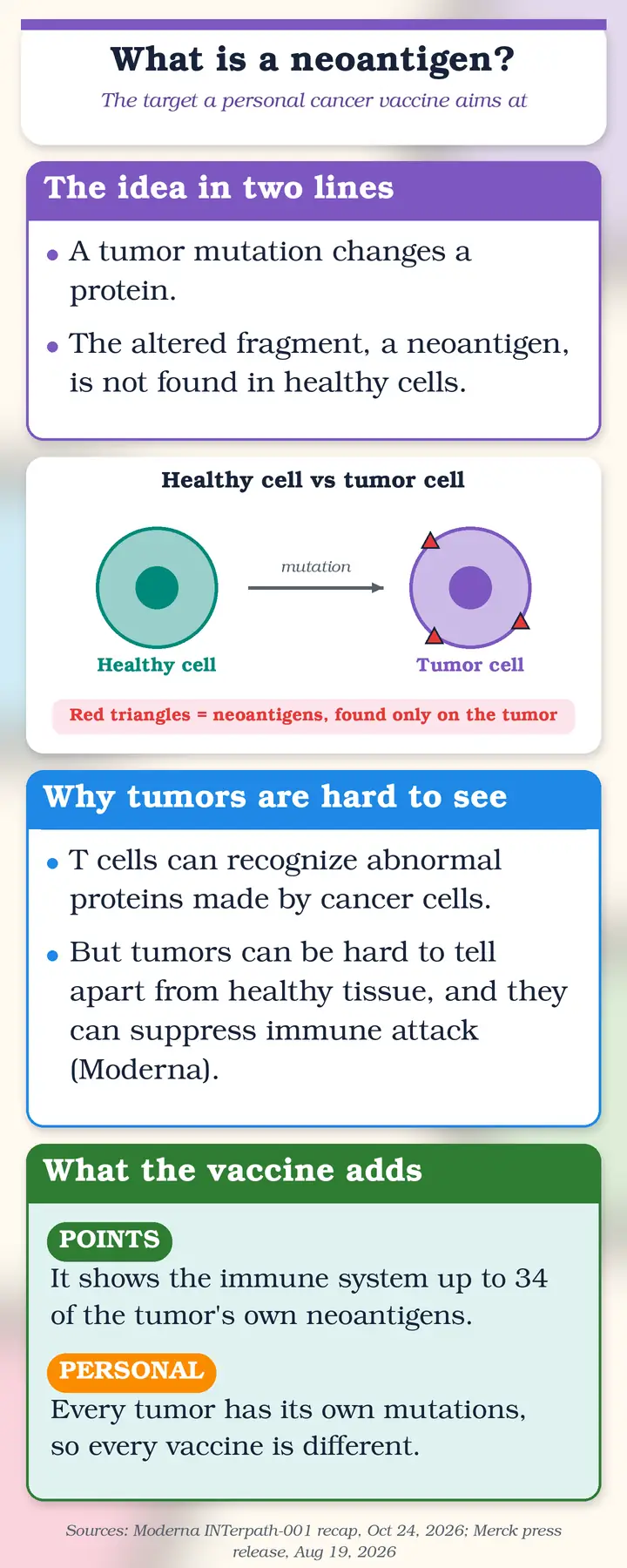
Cancer cells carry mutations that healthy cells do not. Some of those mutations change a protein, and the altered fragment is called a neoantigen. Moderna sets out the logic. T cells can recognize abnormal proteins made by cancer cells, but tumors can be hard for the immune system to tell apart from healthy tissue.
A personalized vaccine points the immune system at those tumor-only fragments. Because every tumor has its own set of mutations, every vaccine is different. If T cells and antigen presentation are new to you, start with our guide to the immune system and its parts.
How a personalized mRNA cancer vaccine is made, step by step
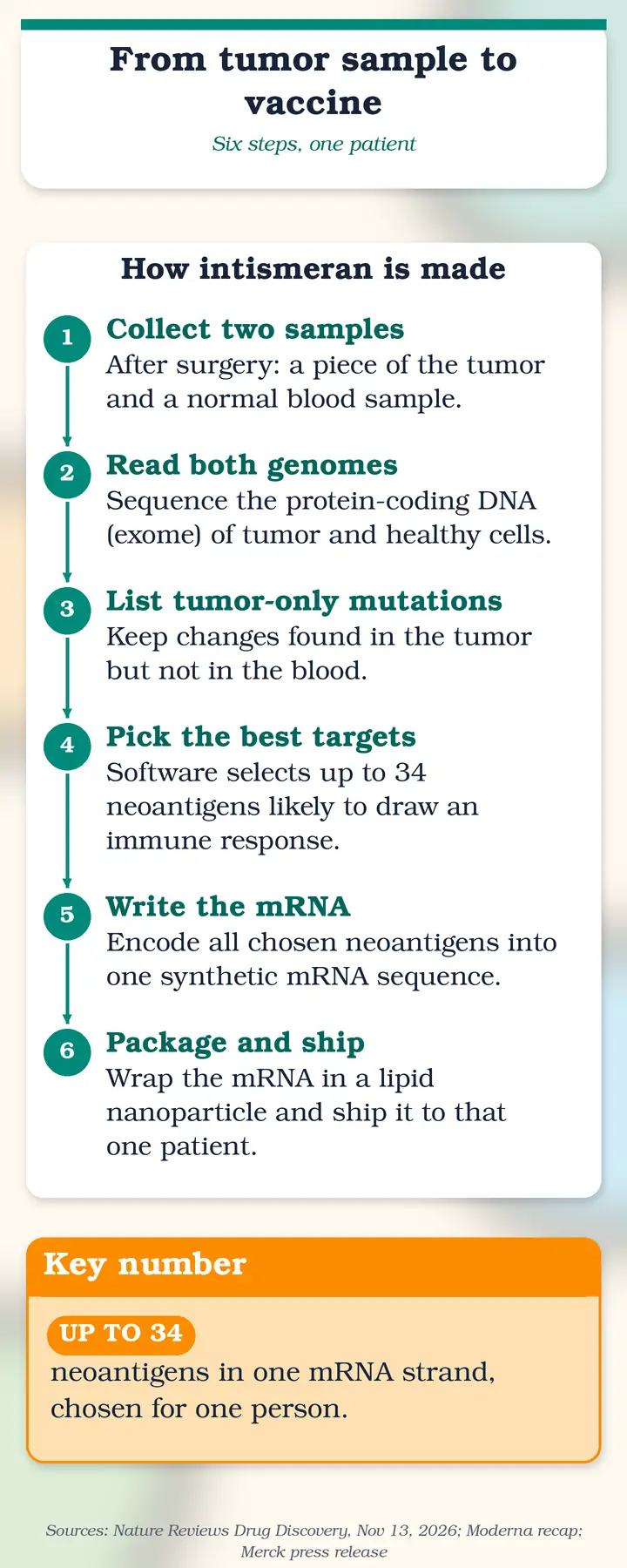
Merck describes intismeran as a therapy “designed specifically for each patient based on the unique set of mutations within their tumor.” Nature Reviews Drug Discovery and Moderna describe the same pipeline.
- Collect two samples. After surgery, doctors send a piece of the tumor and a normal blood sample.
- Read both genomes. The lab sequences the protein-coding DNA (the exome) of tumor and healthy cells and compares them.
- List tumor-only mutations. Any change found in the tumor but not in the blood is a candidate.
- Pick the best targets. Software selects up to 34 neoantigens predicted to draw an immune response.
- Write the mRNA. The factory encodes all chosen neoantigens into one synthetic mRNA sequence.
- Package and ship. The mRNA goes inside a lipid nanoparticle (LNP), and the finished vaccine ships back to that one patient.
What happens after the injection
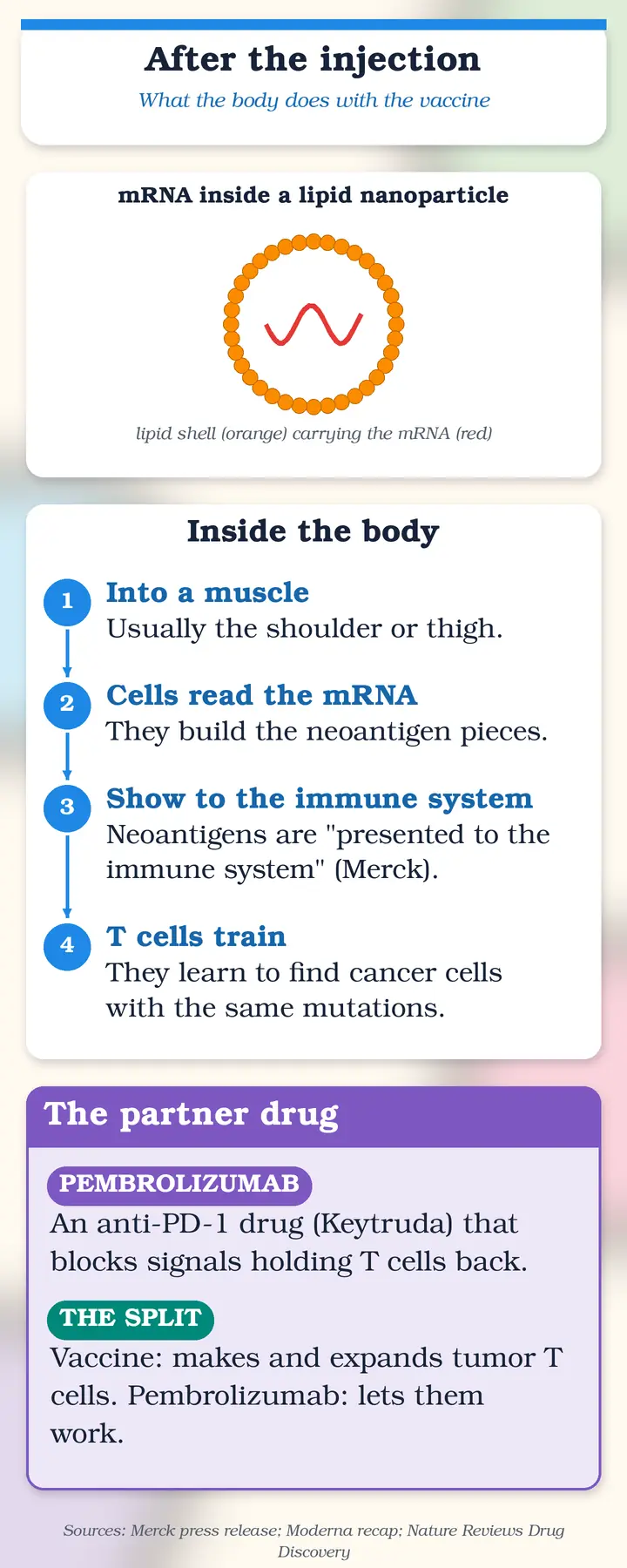
The vaccine goes into a muscle, usually the shoulder or thigh, according to Nature Reviews Drug Discovery. The body’s cells read the mRNA and build the neoantigen pieces. Merck states that these pieces “are translated in the body and presented to the immune system,” which is the step that trains T cells to hunt cancer cells carrying the same mutations.
The mRNA delivery idea is the one behind COVID-19 vaccines. Our explainer on how mRNA vaccines work covers that platform, and our post on lipid and other nanoparticle types explains the fatty bubble that carries the mRNA.
Why doctors pair it with pembrolizumab
Trial patients do not get intismeran alone. They also receive pembrolizumab (Keytruda), an anti-PD-1 drug. Moderna describes the split this way. The vaccine creates and expands tumor-specific T cells, while pembrolizumab blocks signals that would otherwise hold those T cells back.
That makes it a different tool from a classic preventive vaccine, which trains immunity before an infection. Our guide to vaccine types and how they are classified compares the families.
What the Phase 3 trial found
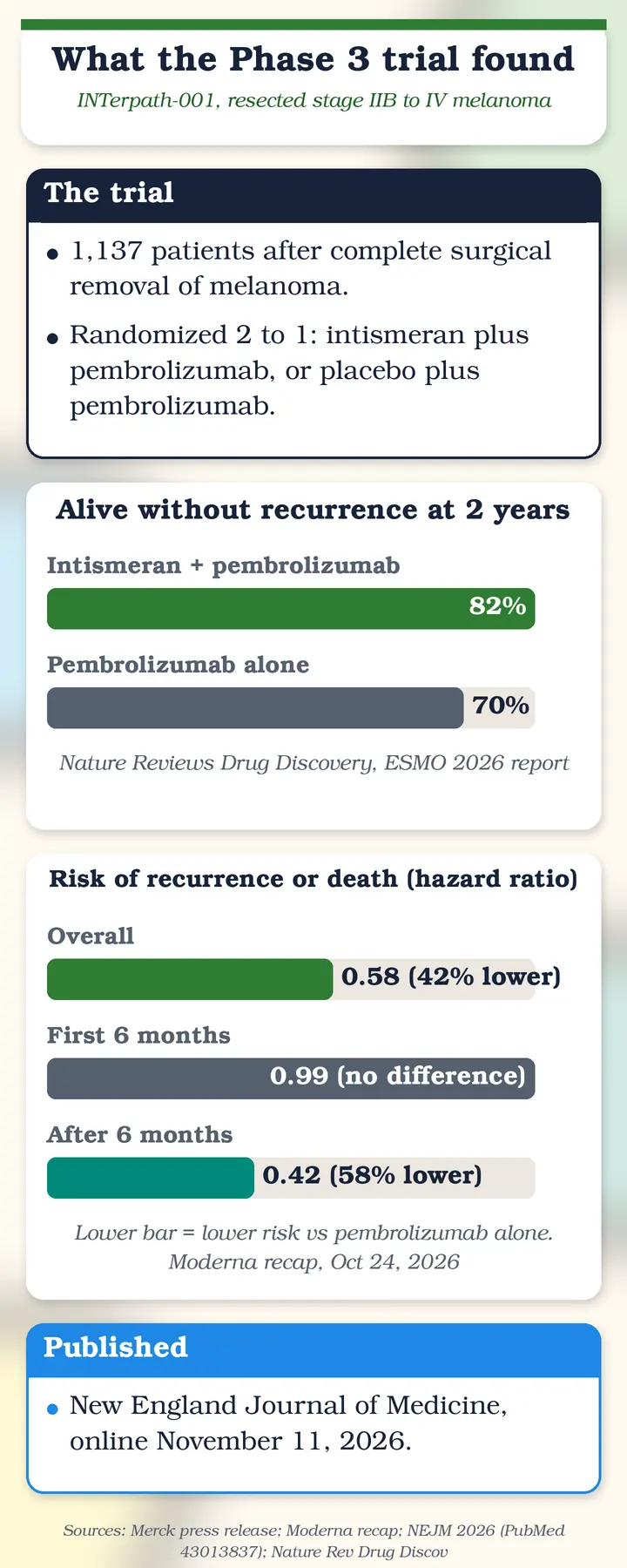
INTerpath-001 enrolled 1,137 people after surgeons had completely removed their stage IIB to IV melanoma. Merck reports that it randomized them 2 to 1 to intismeran plus pembrolizumab or to placebo plus pembrolizumab.
| Measure | Intismeran plus pembrolizumab | Pembrolizumab alone |
|---|---|---|
| Alive without recurrence at 2 years | 82% | 70% |
| Risk of recurrence or death | 42% lower (HR 0.58) | Reference |
| First 6 months | No difference (HR 0.99) | Reference |
| After 6 months | 58% lower (HR 0.42) | Reference |
Look at the timing. The two groups looked the same for six months, and Moderna reports that the gap opened after the immunization course, the same pattern seen in the earlier Phase 2 study. The full results appeared in the New England Journal of Medicine on November 11, 2026.
Where it stands now
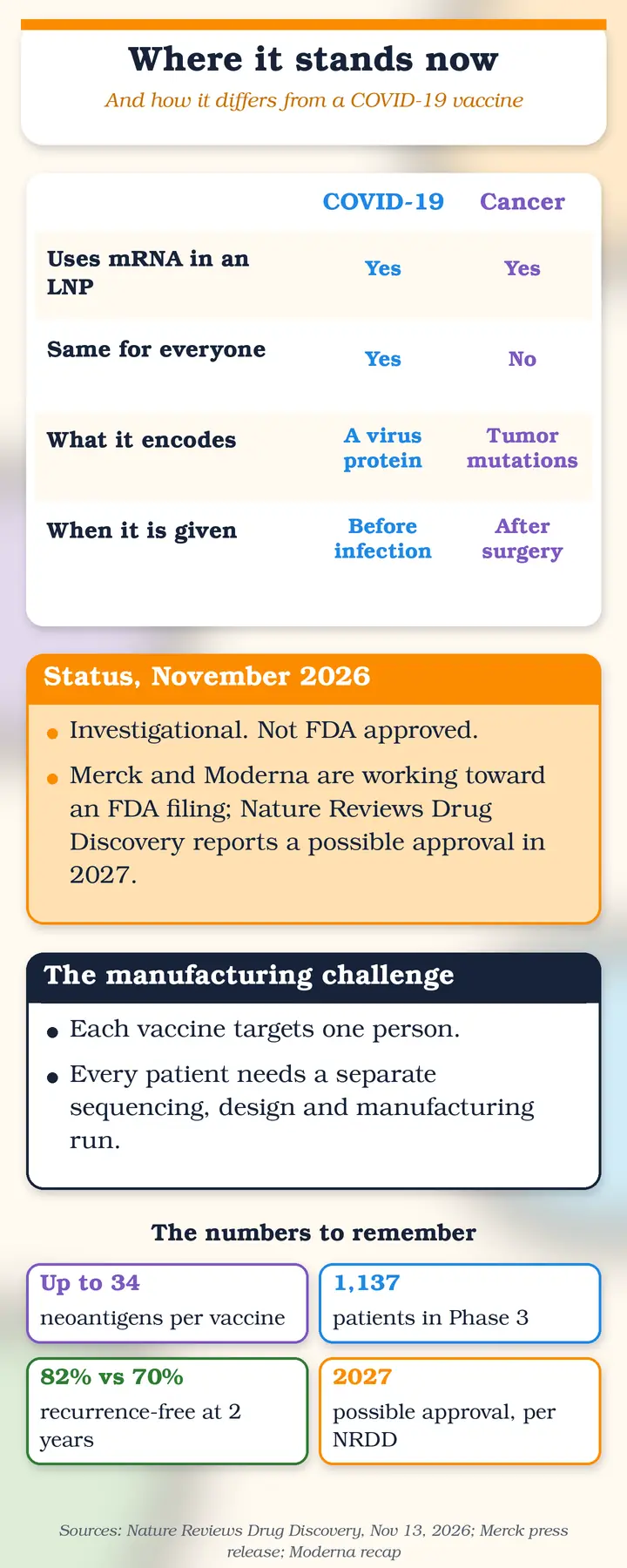
Intismeran is still investigational. Merck and Moderna are working toward an FDA filing, and Nature Reviews Drug Discovery reports that they foresee a possible approval in 2027. Because each vaccine targets one person, every patient needs a separate manufacturing run. Our drug discovery guide explains what a filing involves.
Key takeaways
- A neoantigen is a protein fragment created by a tumor-only mutation.
- The vaccine pipeline runs from tumor and blood sequencing to software target selection, mRNA writing and LNP packaging.
- Intismeran encodes up to 34 neoantigens in one mRNA strand, made for one patient.
- In Phase 3, 82% of patients on the combination were recurrence-free at 2 years versus 70% on pembrolizumab alone.
- The vaccine is not approved yet; the companies foresee a possible 2027 approval.
This article is for general education only and is not medical advice. Intismeran autogene is an investigational therapy. Talk to an oncologist about treatment options and clinical trials.
Frequently asked questions
How is a personalized mRNA cancer vaccine made?
Doctors sequence tumor and blood samples, compare them to find tumor-only mutations, and use software to pick up to 34 targets. A factory writes those targets into one mRNA strand, wraps it in a lipid nanoparticle and ships it back to that patient.
What are neoantigens in cancer?
Neoantigens are altered protein fragments made from mutations that only the tumor carries. Because healthy cells lack them, they give T cells a specific target.
How does the Moderna mRNA cancer vaccine work?
Intismeran’s mRNA tells the body’s cells to make the patient’s neoantigen fragments, which the immune system then learns to recognize. Patients receive it with pembrolizumab, which releases a brake on T cells.
How effective are mRNA cancer vaccines?
In the Phase 3 INTerpath-001 melanoma trial, 82% of patients on intismeran plus pembrolizumab were alive without recurrence at 2 years, versus 70% on pembrolizumab alone. The risk of recurrence or death was 42% lower (HR 0.58).
How is intismeran administered?
Doctors inject it into a muscle, usually the shoulder or thigh, according to Nature Reviews Drug Discovery. In the trial, patients received it alongside pembrolizumab after surgery had removed their melanoma.
When will the mRNA cancer vaccine be available?
Not yet. As of November 2026, intismeran autogene is investigational and not FDA approved. Merck and Moderna are working toward an FDA filing, and Nature Reviews Drug Discovery reports a possible approval in 2027.
Sources
- Merck. Merck and Moderna announce Phase 3 INTerpath-001 trial of intismeran autogene plus Keytruda met endpoints. Press release, August 19, 2026.
- Moderna. Recapping the Phase 3 INTerpath-001 results. October 24, 2026.
- Long GV, Khattak MA, Gogas HJ, et al. Intismeran autogene plus pembrolizumab for resected stage IIB to IV melanoma. New England Journal of Medicine. Published online November 11, 2026. doi:10.1056/NEJMoa2609762.
- Nature Reviews Drug Discovery. Cancer vaccine development gets complicated. November 13, 2026.