
Last updated: November 14, 2026 · Dr Nidhi Joshi
In short: A peptide drug is a medicine made of a short chain of amino acids, usually 500 to 5,000 daltons in size, that acts on specific targets in the body. Insulin, semaglutide and leuprolide are all peptide drugs. This guide explains how companies design and make peptide drugs, why most are injected, and why vials sold online as “research peptides” are not approved medicines.
What is a peptide drug, chemically?
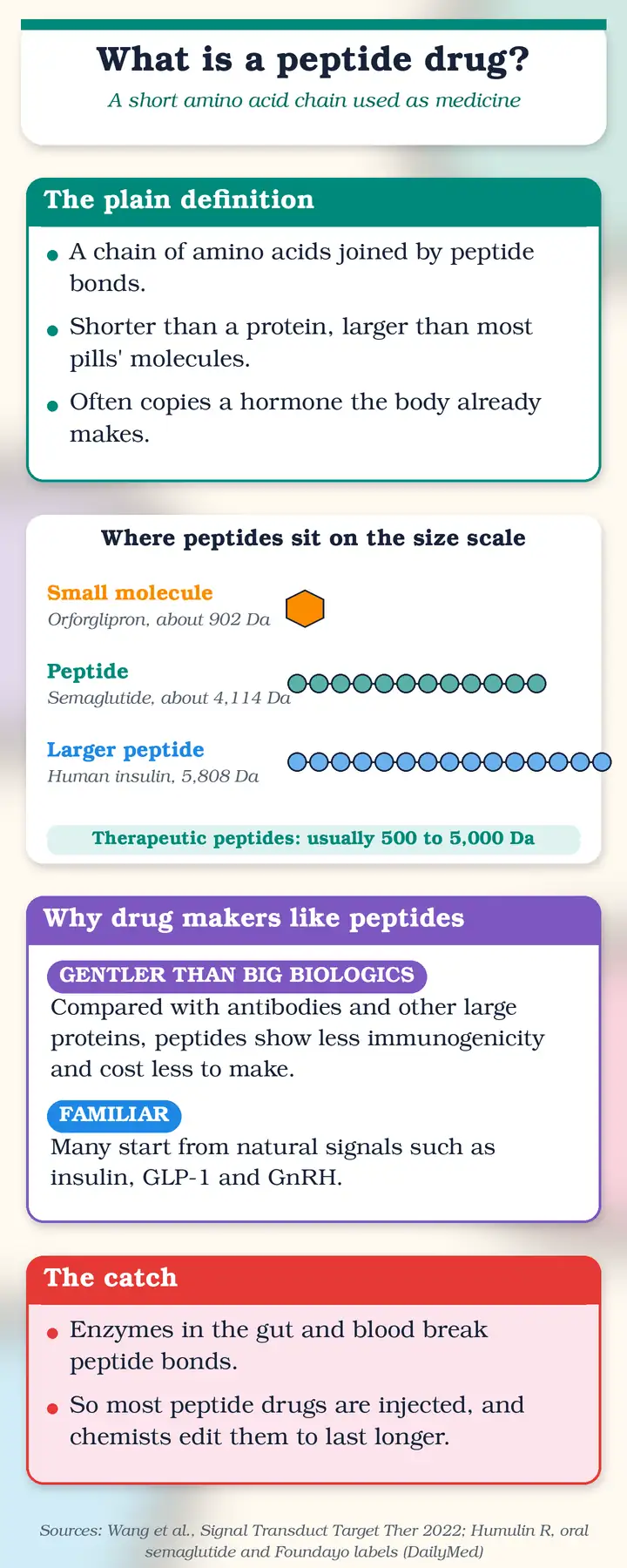
A peptide is a chain of amino acids joined by peptide bonds. Proteins are longer chains of the same building blocks, so the line between the two is about size. A 2022 review in Signal Transduction and Targeted Therapy puts most therapeutic peptides at 500 to 5,000 daltons. For scale, recombinant human insulin weighs 5,808 daltons and semaglutide 4,114.
Many peptide drugs copy a hormone the body already makes. GLP-1 is a 37-amino-acid hormone, and drugs such as semaglutide are edited versions of it. Our guide to how GLP-1 drugs work explains those edits. Our guide to the main protein types and how amino acid chains fold covers the chemistry in more depth.
Examples of approved peptide drugs
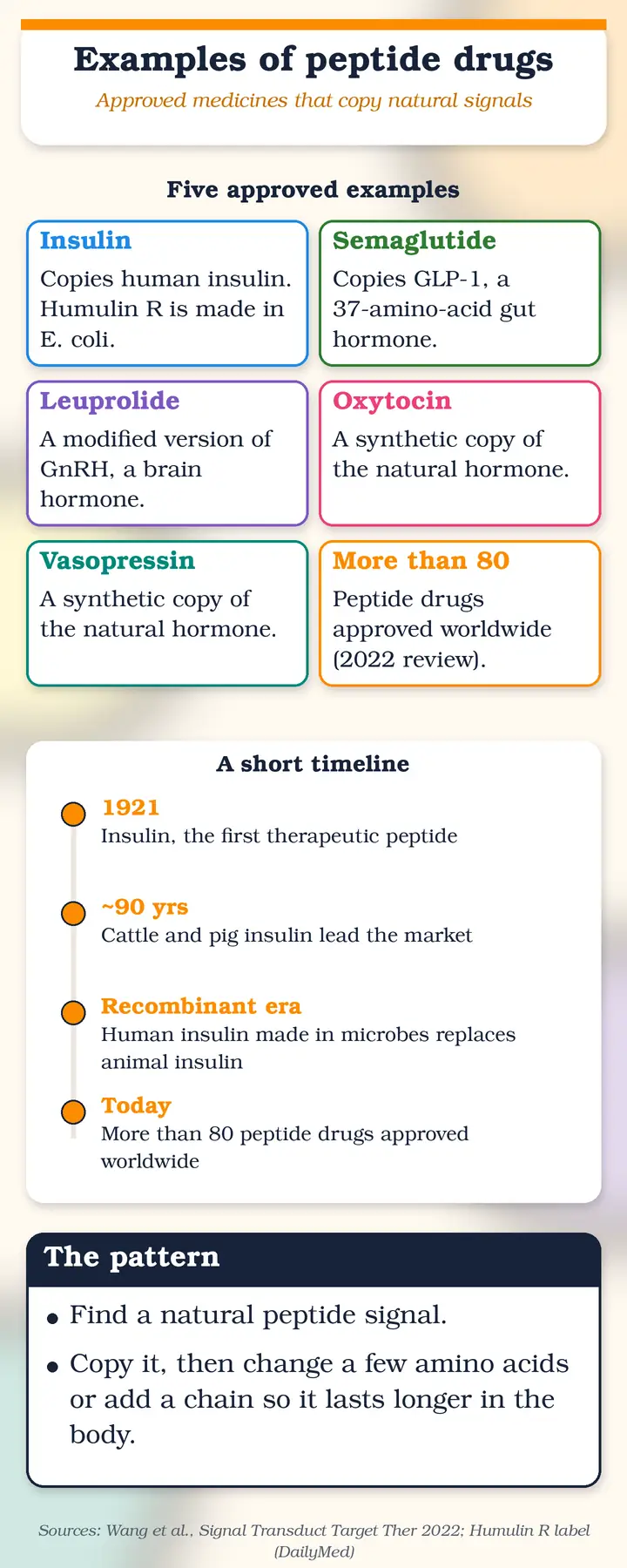
The same review counts more than 80 peptide drugs approved worldwide. Most began as natural signals that researchers learned to copy or stabilize.
| Peptide drug | Natural model | How it is made or changed |
|---|---|---|
| Insulin (Humulin R) | Human insulin | Same sequence, made in E. coli |
| Semaglutide | GLP-1 | Yeast-made backbone, edited to resist enzymes, plus a fatty acid chain |
| Leuprolide | GnRH | Modified version of the natural sequence |
| Oxytocin | Oxytocin | Synthetic copy of the hormone |
| Vasopressin | Vasopressin | Synthetic copy of the hormone |
Insulin came first. The review dates it to 1921, and insulin from cattle and pigs dominated the market for almost 90 years until recombinant human insulin replaced it. If hormones as messengers are new to you, start with how hormones carry signals around the body.
How peptide drugs are made
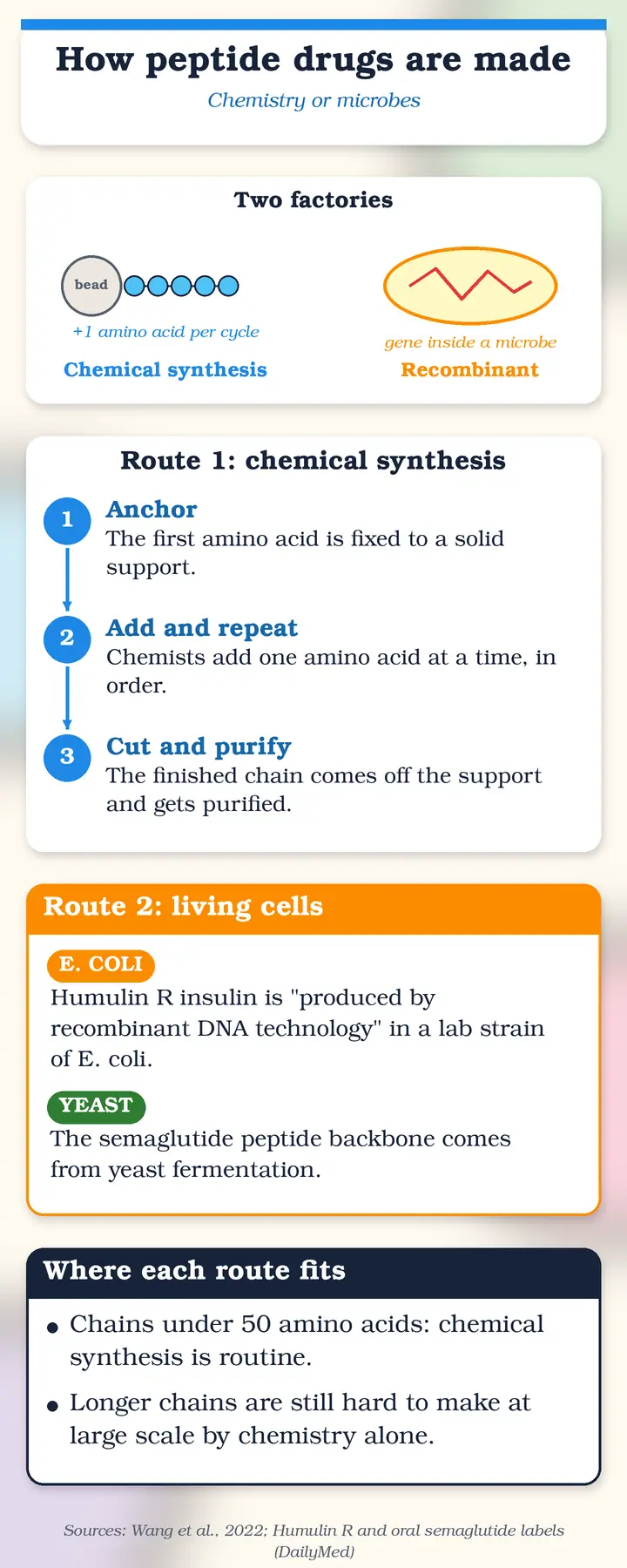
Drug companies use two main routes. The first is chemical synthesis on a solid support, building the chain one amino acid at a time. The review notes that this works routinely for chains under 50 amino acids, while longer chains stay hard to make at scale.
The second route is biological. The Humulin R label states that its insulin is “produced by recombinant DNA technology utilizing a non-pathogenic laboratory strain of Escherichia coli.” The oral semaglutide label says its peptide backbone comes from yeast fermentation. Our explainer on how recombinant DNA technology works shows how a human gene ends up inside a microbe.
Why most peptide drugs are injected
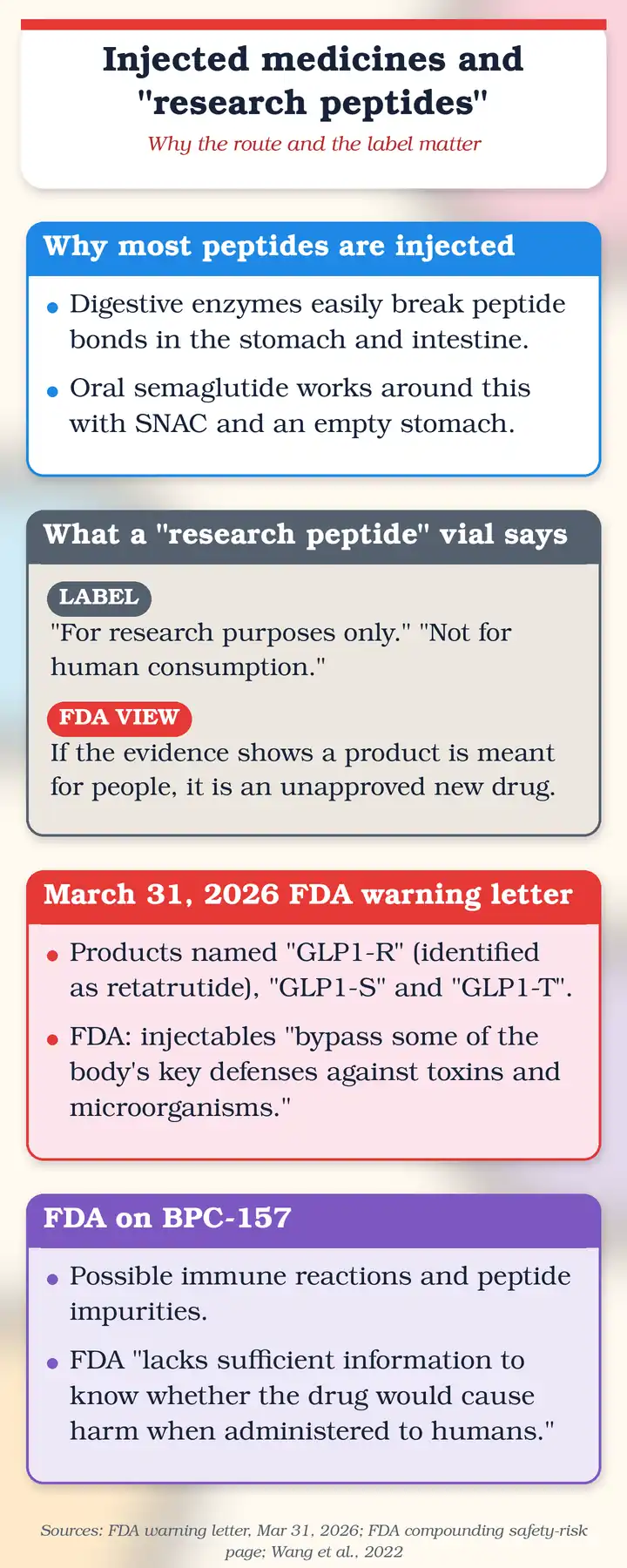
Digestive enzymes in the stomach and intestine easily break peptide bonds, the review explains, so most peptide drugs reach the body by injection. Our post on what enzymes are and how they cut molecules explains the chemistry.
Chemists have found partial workarounds. Semaglutide carries a fatty acid chain that binds albumin, which stretches its half-life to about one week. Oral semaglutide adds an absorption helper, salcaprozate sodium (SNAC), and its label requires an empty stomach.
What “research peptides” are, and what they are not
Online shops sell vials labeled “for research purposes only” or “not for human consumption.” The FDA does not accept that label as a shield. In a March 31, 2026 warning letter, the agency found that a site selling products named “GLP1-R” (identified as retatrutide), “GLP1-S” and “GLP1-T” was offering unapproved new drugs, because its own website showed the products were meant for people.
The FDA also flagged the route. Its letter notes that injectable products “bypass some of the body’s key defenses against toxins and microorganisms.” For BPC-157, the FDA’s compounding safety page says the agency “lacks sufficient information to know whether the drug would cause harm when administered to humans” and lists possible immune reactions and impurities.
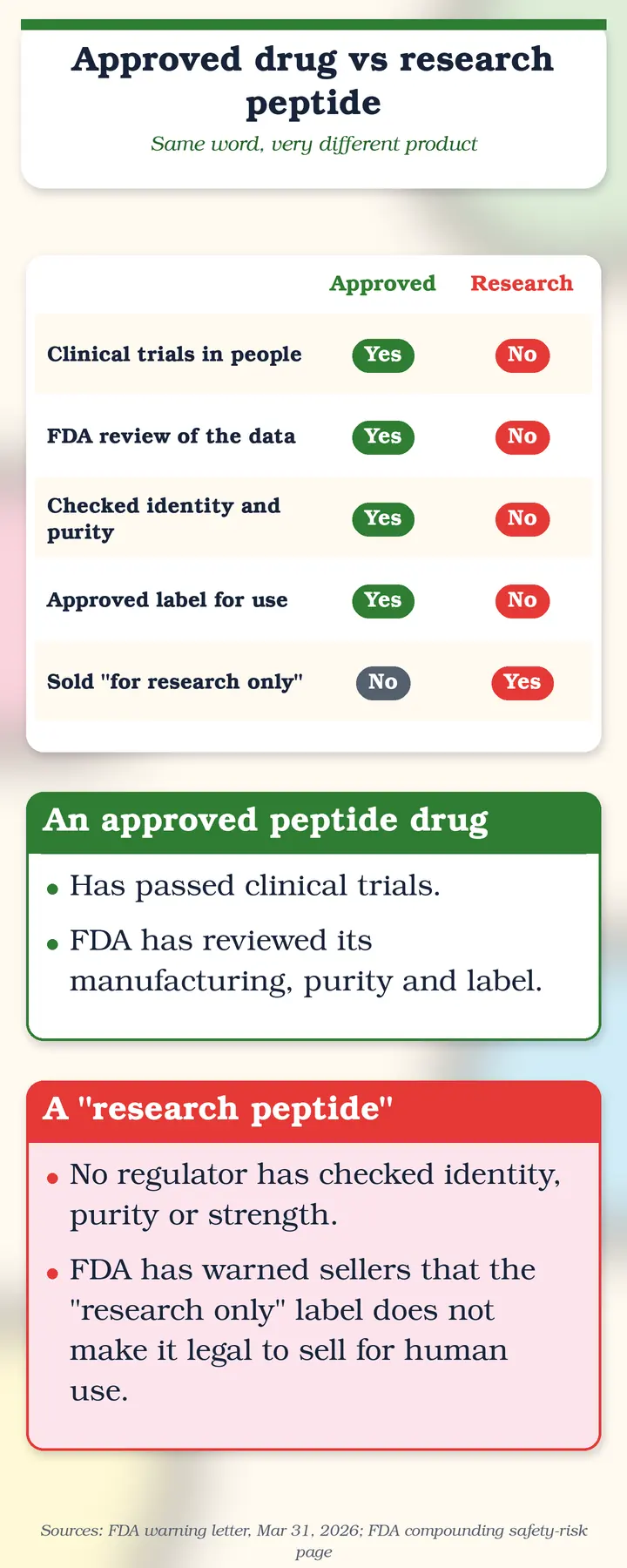
Approved peptide drug vs research peptide
An approved peptide drug has passed clinical trials and an FDA review of its manufacturing, purity and label. Our drug discovery guide walks through those stages. A research peptide skips all of it. No regulator has checked the vial’s identity, purity or strength, which are the impurity and ingredient problems the FDA’s compounding page describes for peptides like BPC-157.
Key takeaways
- A peptide drug is a short amino acid chain, usually 500 to 5,000 daltons, that often copies a natural hormone.
- Regulators worldwide have approved more than 80 peptide drugs, starting with insulin.
- Companies make them by chemical synthesis or in engineered microbes such as E. coli and yeast.
- Most are injected because digestive enzymes break peptide bonds.
- The FDA treats “research use only” peptides sold for human use as unapproved new drugs.
This article is for general education only and is not medical advice. It does not recommend any drug, dose, product or seller. Talk to a doctor or pharmacist about medicines that are right for you.
Frequently asked questions
What is a peptide drug?
A peptide drug is a medicine built from a short chain of amino acids, usually 500 to 5,000 daltons. It acts on specific targets in the body, often by copying a natural hormone. Insulin and semaglutide are examples.
What are examples of peptide drugs?
Approved examples include insulin, semaglutide, leuprolide, synthetic oxytocin and synthetic vasopressin. A 2022 review counts more than 80 peptide drugs approved worldwide.
How are peptide drugs manufactured?
Companies either build the chain chemically, one amino acid at a time on a solid support, or make it in engineered microbes. Humulin R insulin comes from a lab strain of E. coli, and the semaglutide backbone comes from yeast fermentation.
Can peptide drugs be taken orally?
Rarely. Digestive enzymes break peptide bonds in the stomach and intestine, which is why most peptide drugs go in by injection. Oral semaglutide is an exception that uses an absorption helper called SNAC and an empty stomach.
Are research peptides legal?
Not as medicines. “Research peptides” sold online are not FDA approved, and the FDA has warned sellers that a “research purposes only” label does not stop a product from being an unapproved new drug when the evidence shows it is meant for people.
Are peptides the same as GLP-1 drugs?
No. GLP-1 drugs such as semaglutide are one group of peptide drugs. Insulin, leuprolide and oxytocin are peptide drugs too.
Sources
- Wang L, Wang N, Zhang W, et al. Therapeutic peptides: current applications and future directions. Signal Transduction and Targeted Therapy. 2022;7:48.
- DailyMed, NLM. Humulin R (insulin human) injection, prescribing information.
- DailyMed, NLM. Rybelsus and Ozempic (oral semaglutide) tablets, prescribing information.
- U.S. Food and Drug Administration. Warning letter on unapproved GLP-1 “research” products, March 31, 2026.
- U.S. Food and Drug Administration. Certain bulk drug substances for use in compounding that may present significant safety risks.