

Last updated: November 14, 2026 · Dr Nidhi Joshi
In short: GLP-1 drugs copy a gut hormone and switch on its receptor in the pancreas and brain, so insulin rises after a meal, glucagon falls and appetite drops. That is how GLP-1 drugs work at the simplest level, and newer dual and triple agonists switch on extra hormone receptors too. This guide explains each type, how a GLP-1 pill gets past the stomach, and the vision warning the FDA added in November 2026.
What GLP-1 is and what its receptor does
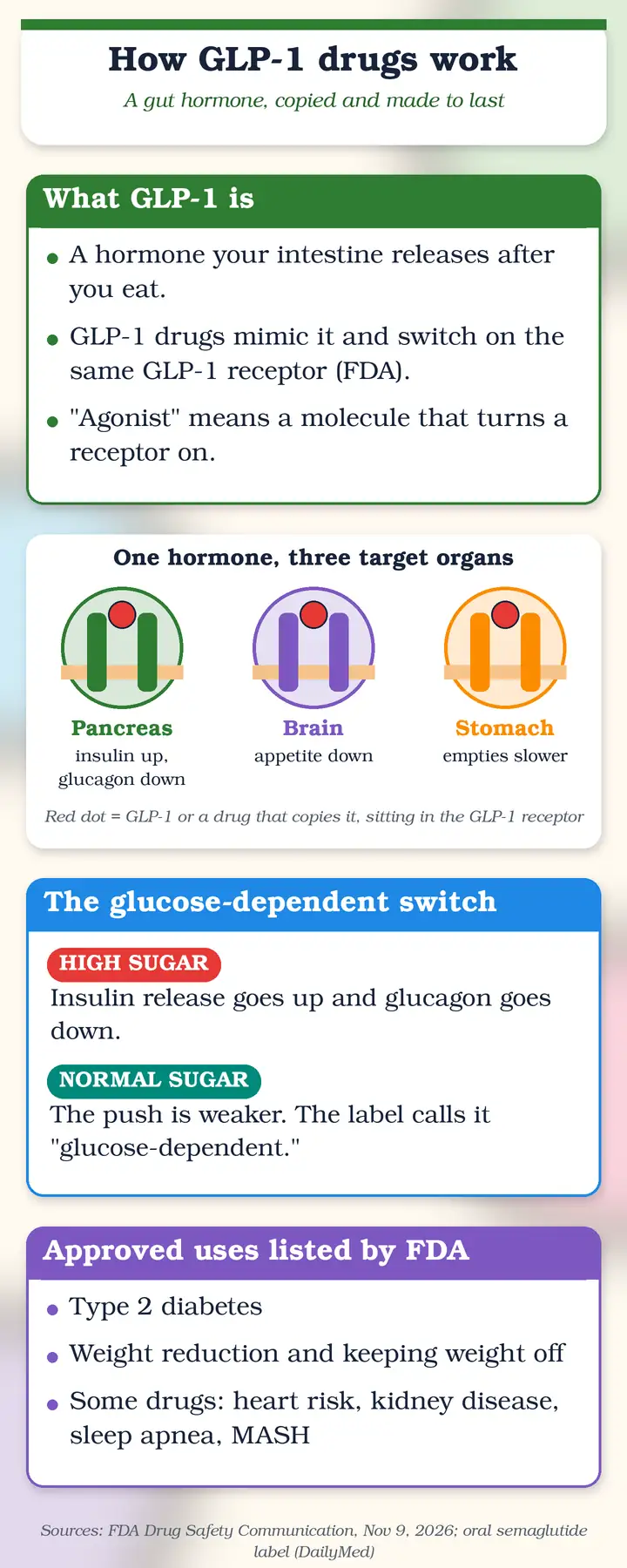
Glucagon-like peptide-1 (GLP-1) is a hormone your intestine releases after you eat. The FDA describes GLP-1 receptor agonists as drugs that mimic this hormone, which lowers blood sugar after meals and acts on brain areas that control appetite and food intake. An agonist is a molecule that switches a receptor on.
The switch is conditional. The semaglutide label says the drug raises insulin and lowers glucagon “in a glucose-dependent manner,” so the push is strongest when blood sugar is high. It also slows how fast the stomach empties in the first hours after a meal. Our guide to how hormones act as chemical messengers covers the basics.
Why the drug lasts a week when your own GLP-1 does not
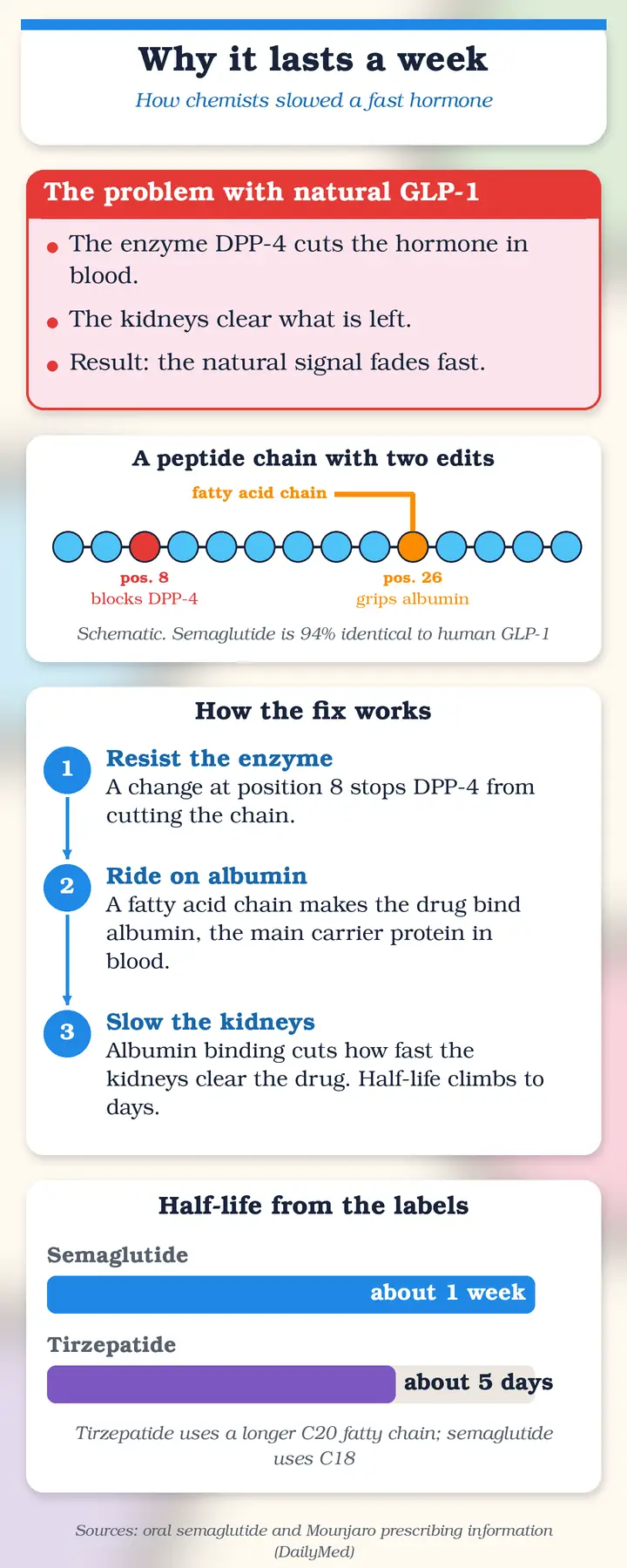
Natural GLP-1 does not last long in blood. An enzyme called DPP-4 cuts it, and the kidneys clear what is left. Chemists fixed both problems by editing the peptide.
Semaglutide shares 94% of its amino acid sequence with human GLP-1. A change at position 8 blocks DPP-4. A fatty acid chain attached at position 26 makes the molecule stick to albumin, the main carrier protein in blood, which slows clearance by the kidneys.
The result is a half-life of about one week. Tirzepatide uses a longer fatty chain and has a half-life of about five days. Our post on albumin and the other protein types in your body covers carrier proteins.
Single, dual and triple agonists compared
The drugs differ in how many receptors one molecule switches on.
| Drug (brand examples) | Receptors it activates | How it is taken | US status, Nov 2026 |
|---|---|---|---|
| Semaglutide (Ozempic, Wegovy, Rybelsus) | GLP-1 | Weekly injection or daily tablet | FDA approved |
| Tirzepatide (Mounjaro, Zepbound) | GIP and GLP-1 | Weekly injection | FDA approved |
| Orforglipron (Foundayo) | GLP-1 | Daily tablet | FDA approved, 2026 |
| Retatrutide | GIP, GLP-1 and glucagon | Weekly injection | Investigational, Phase 3 |
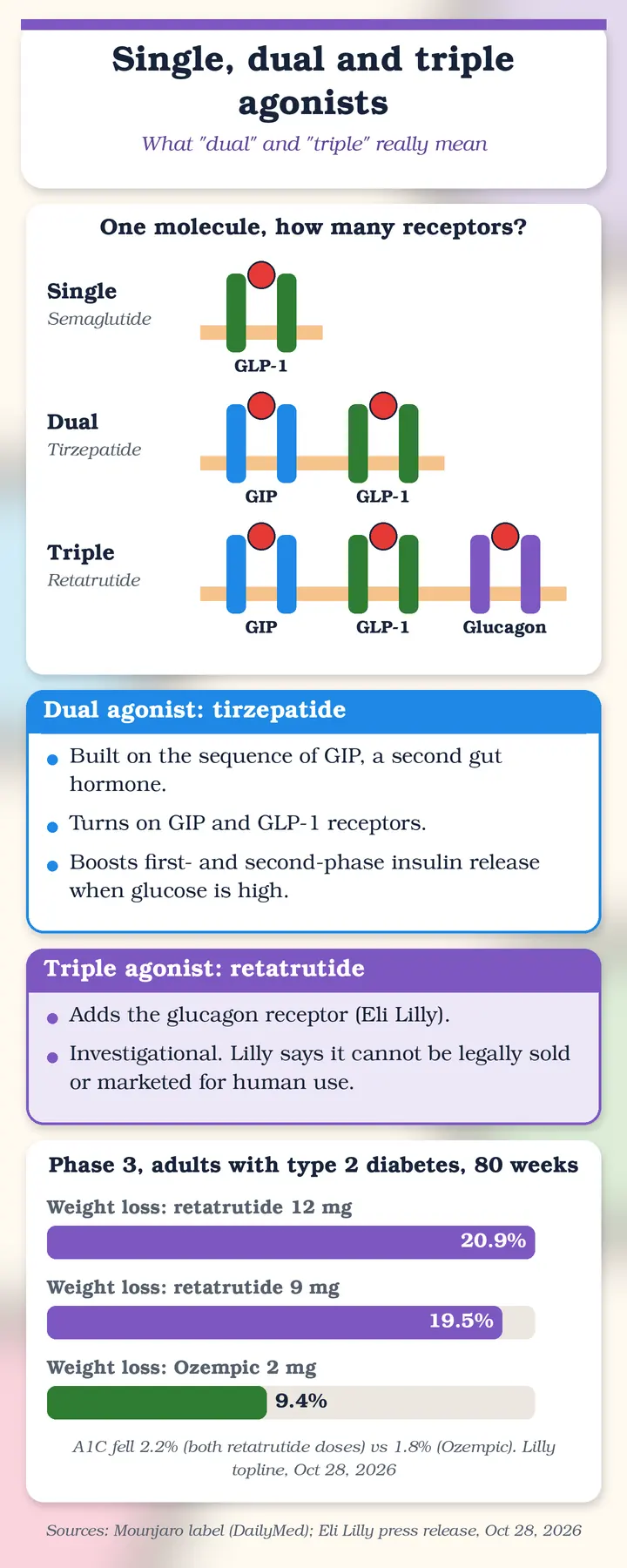
What is a dual agonist? Tirzepatide starts from the sequence of GIP, a second gut hormone, and activates both the GIP and GLP-1 receptors. Its label says it boosts the first and second phases of insulin release and lowers glucagon, again only when glucose is high.
What is a triple agonist? Eli Lilly describes retatrutide as one molecule that activates the GIP, GLP-1 and glucagon receptors. On October 28, 2026, Lilly reported a Phase 3 trial in adults with type 2 diabetes.
After 80 weeks, A1C fell by 2.2% on retatrutide versus 1.8% on Ozempic 2 mg, and weight fell by 19.5% to 20.9% versus 9.4%. Phase 3 is the last stage before a company files for approval, as our step-by-step drug discovery guide shows. Lilly states that retatrutide cannot be legally sold for human use.
How do GLP-1 pills work?
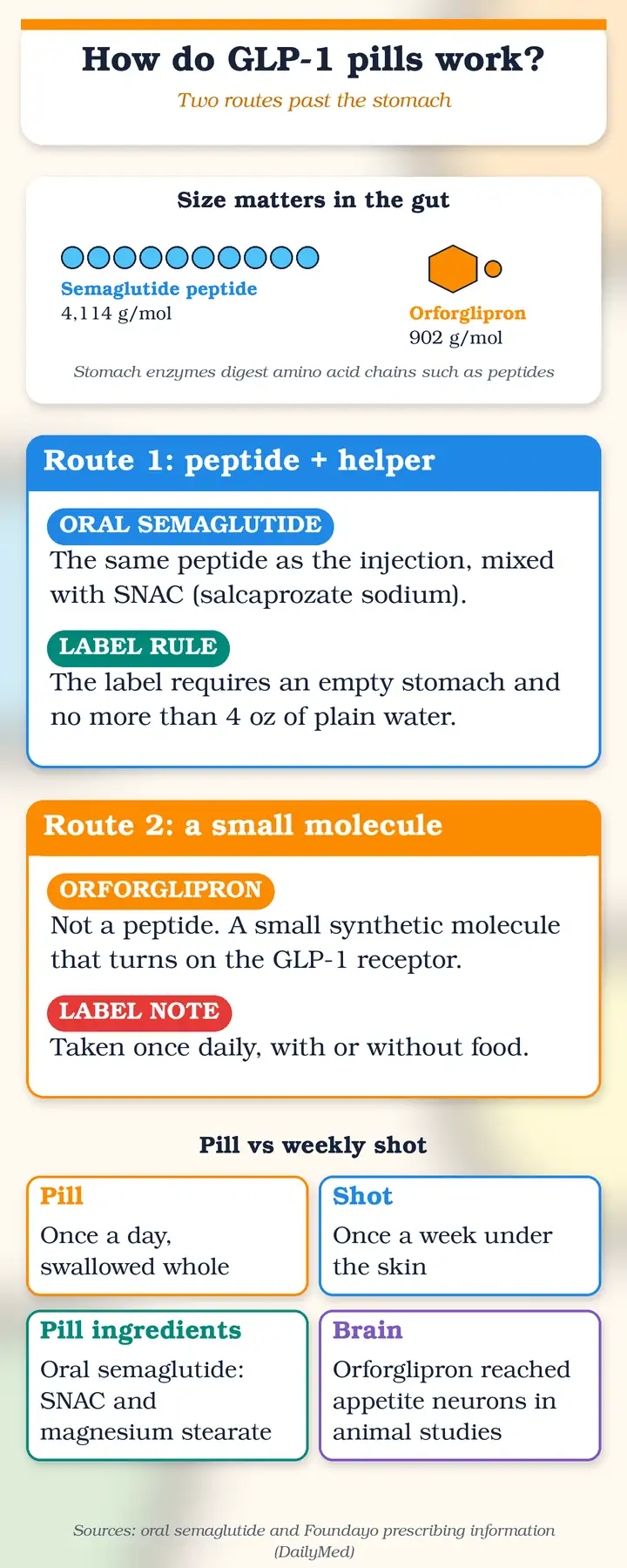
A peptide is a chain of amino acids, and the stomach digests chains like that. Two pills take different routes around this.
Oral semaglutide carries the same peptide plus an absorption helper called salcaprozate sodium (SNAC). Its label lists only two inactive ingredients, SNAC and magnesium stearate, and requires an empty stomach with no more than 4 ounces of plain water.
Orforglipron skips the peptide problem. It is a small synthetic molecule weighing about 902 g/mol, compared with about 4,114 g/mol for semaglutide, and its label says to take it with or without food. Our guide to how tablets are made and coated covers the tablet side of that story.
How GLP-1 drugs work in the body, step by step
- The drug enters the blood from the injection site or the gut.
- It binds GLP-1 receptors on beta cells in the pancreas, which release more insulin when glucose is high.
- Alpha cells in the pancreas release less glucagon.
- The stomach empties a little more slowly early after a meal.
- Receptors in appetite regions of the brain respond, and people eat less. The Foundayo label says this effect is “likely mediated by decreased appetite.”
The FDA’s November 2026 NAION warning
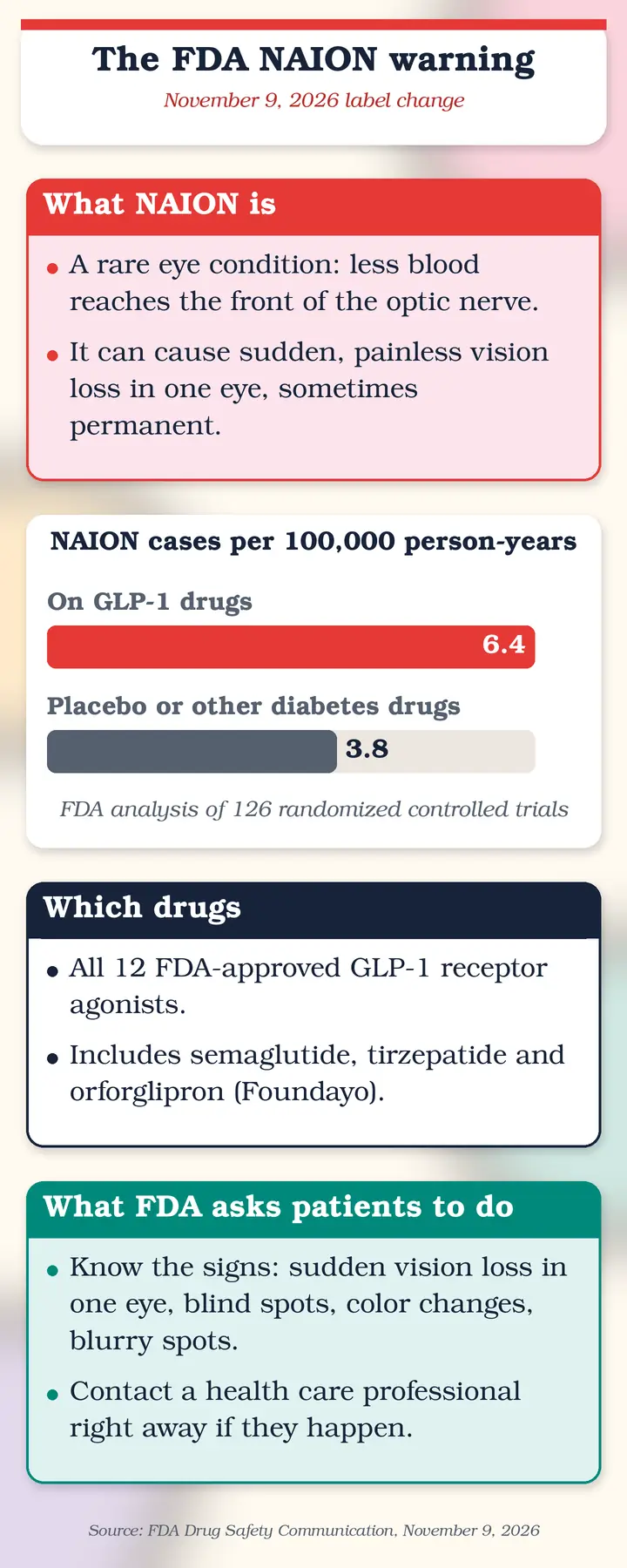
On November 9, 2026, the FDA required every GLP-1 receptor agonist label to add a warning about NAION. NAION is a rare condition in which reduced blood flow to the front of the optic nerve causes sudden, painless vision loss in one eye. The FDA’s list covers all 12 approved products, including tirzepatide and orforglipron.
The numbers come from an FDA analysis of 126 randomized trials. It found 6.4 NAION cases per 100,000 person-years on GLP-1 drugs and 3.8 on placebo or other diabetes drugs. The FDA asks patients to contact a health care professional right away about sudden vision changes.
Key takeaways
- GLP-1 drugs copy a gut hormone and raise insulin only when blood sugar is high.
- Edits that resist DPP-4 and grip albumin stretch the effect to about a week.
- Tirzepatide is a dual agonist (GIP and GLP-1); retatrutide is an investigational triple agonist that adds the glucagon receptor.
- Oral semaglutide uses SNAC to cross the stomach lining, while orforglipron is a small molecule.
- Since November 9, 2026, all GLP-1 drug labels must warn about NAION.
This article is for general education only and is not medical advice. It does not recommend any drug, dose or schedule. Talk to a doctor or pharmacist about medicines that are right for you.
Frequently asked questions
How do GLP-1 drugs work?
They bind the GLP-1 receptor, the same receptor your gut hormone uses. In the pancreas this raises insulin and lowers glucagon when blood sugar is high. In the brain it reduces appetite, and in the stomach it slows emptying after meals.
Is tirzepatide a GLP-1?
Yes. Tirzepatide activates both the GIP and GLP-1 receptors, so it is a dual agonist, and the FDA lists it among GLP-1 receptor agonists.
What is a triple agonist?
A triple agonist is one molecule that switches on three hormone receptors. Retatrutide, an investigational Lilly drug, activates the GIP, GLP-1 and glucagon receptors. It is still in Phase 3 trials and is not FDA approved.
How do GLP-1 pills work?
Oral semaglutide pairs the peptide with SNAC, a helper that lets it cross the stomach lining. Orforglipron is a small synthetic molecule, not a peptide, that activates the GLP-1 receptor, and its label allows it with or without food.
Is GLP-1 a peptide?
Yes. Natural GLP-1 is a peptide hormone, and semaglutide and tirzepatide are modified peptides. Orforglipron is the exception, a small molecule that switches on the same receptor.
Can GLP-1 drugs cause vision loss?
The FDA added a warning on November 9, 2026 about a possible increased risk of NAION, a rare cause of sudden vision loss in one eye. Its trial analysis found 6.4 cases per 100,000 person-years on GLP-1 drugs versus 3.8 on comparators.
Sources
- U.S. Food and Drug Administration. FDA requires safety labeling changes for GLP-1 receptor agonists due to potential risk of NAION. Drug Safety Communication, November 9, 2026.
- DailyMed, NLM. Rybelsus and Ozempic (oral semaglutide) tablets, prescribing information.
- DailyMed, NLM. Mounjaro (tirzepatide) injection, prescribing information.
- DailyMed, NLM. Foundayo (orforglipron) tablets, prescribing information.
- Eli Lilly and Company. Retatrutide TRANSCEND-T2D-2 topline results. Press release, October 28, 2026.