

In late 2020, people who had never thought about molecular biology were suddenly saying “mRNA” over dinner. It sounded brand new. It isn’t. The science goes back decades, and step by step it’s easier to follow than the headlines suggested.
If you want the bigger picture first, my earlier post on vaccine types and classification covers live, inactivated, subunit and the other kinds. In this post we’ll stay with one mRNA vaccine and follow it from the lab into your cells, and then on to immune memory.
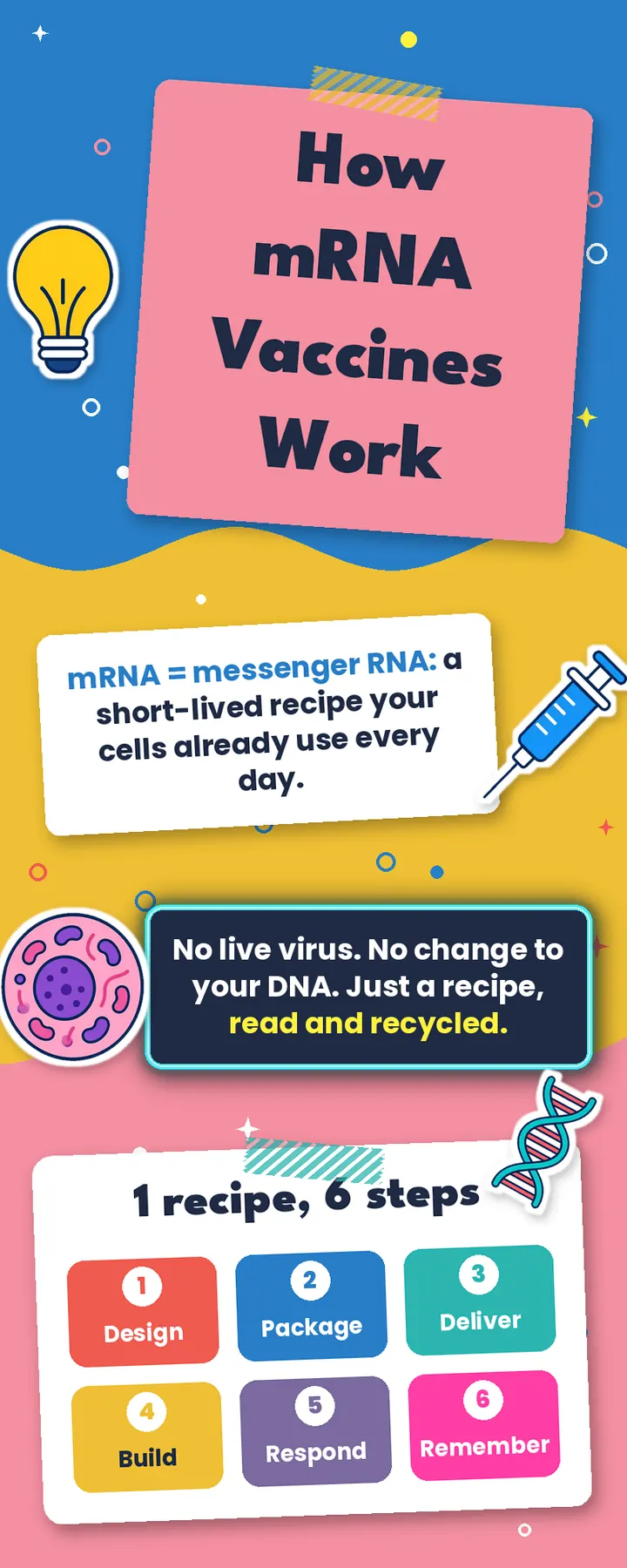
What is mRNA?
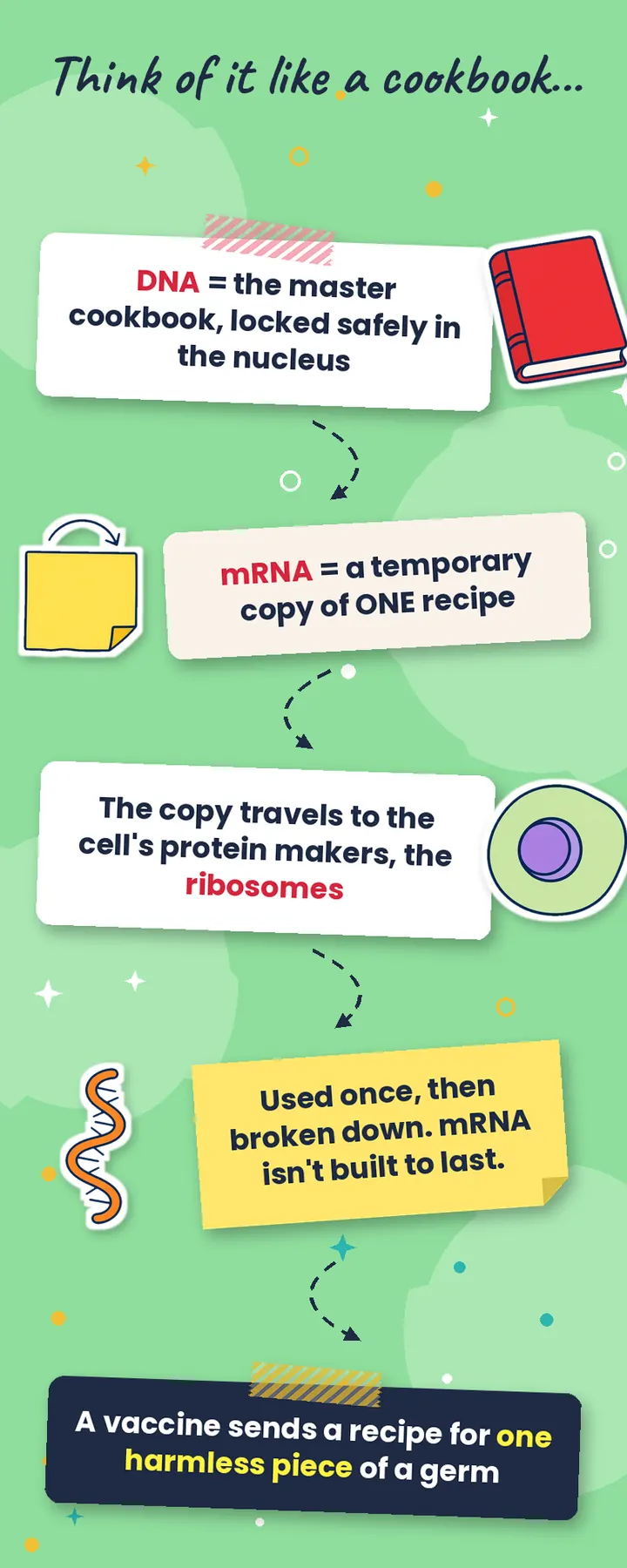
Think of your DNA as a master cookbook that stays in the nucleus of each cell. When the cell needs a protein, it copies one recipe onto a quick, temporary note.
That note is messenger RNA, or mRNA.
The note leaves the nucleus and goes to the cell’s protein-making machinery. After the protein is made, the cell breaks the note down. mRNA isn’t meant to last, and as you’ll see, that turns out to be useful.
An mRNA vaccine borrows this everyday process. It doesn’t give your body a weakened germ. It gives your cells the recipe for one harmless piece of that germ.
Step 1: Designing the message
Every mRNA vaccine starts with two decisions: which protein the immune system should learn, and how to build a message that cells can actually use.
Choosing the target protein
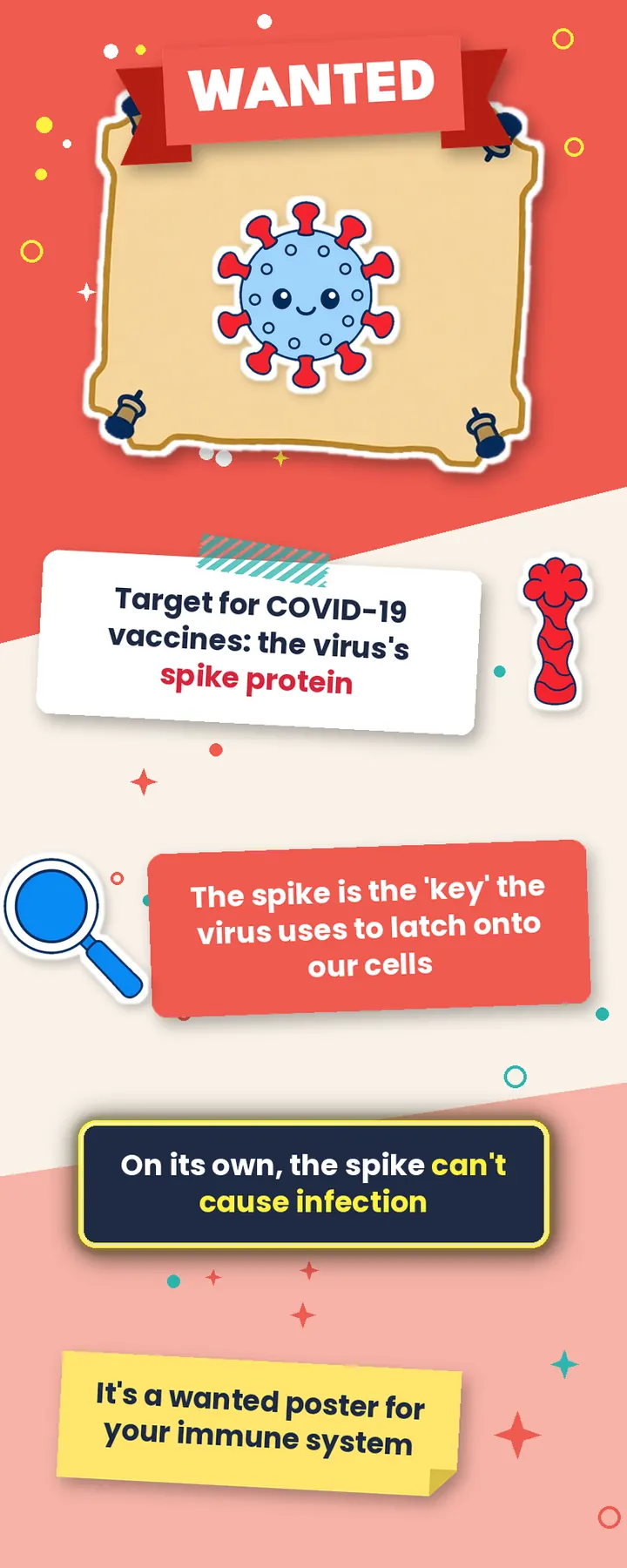
First, scientists pick a protein they want the immune system to learn. For the COVID-19 vaccines, that was the virus’s spike protein, the part it uses to latch onto our cells. A spike protein alone can’t cause infection. You can think of it as a “wanted poster.”
Making and tuning the mRNA
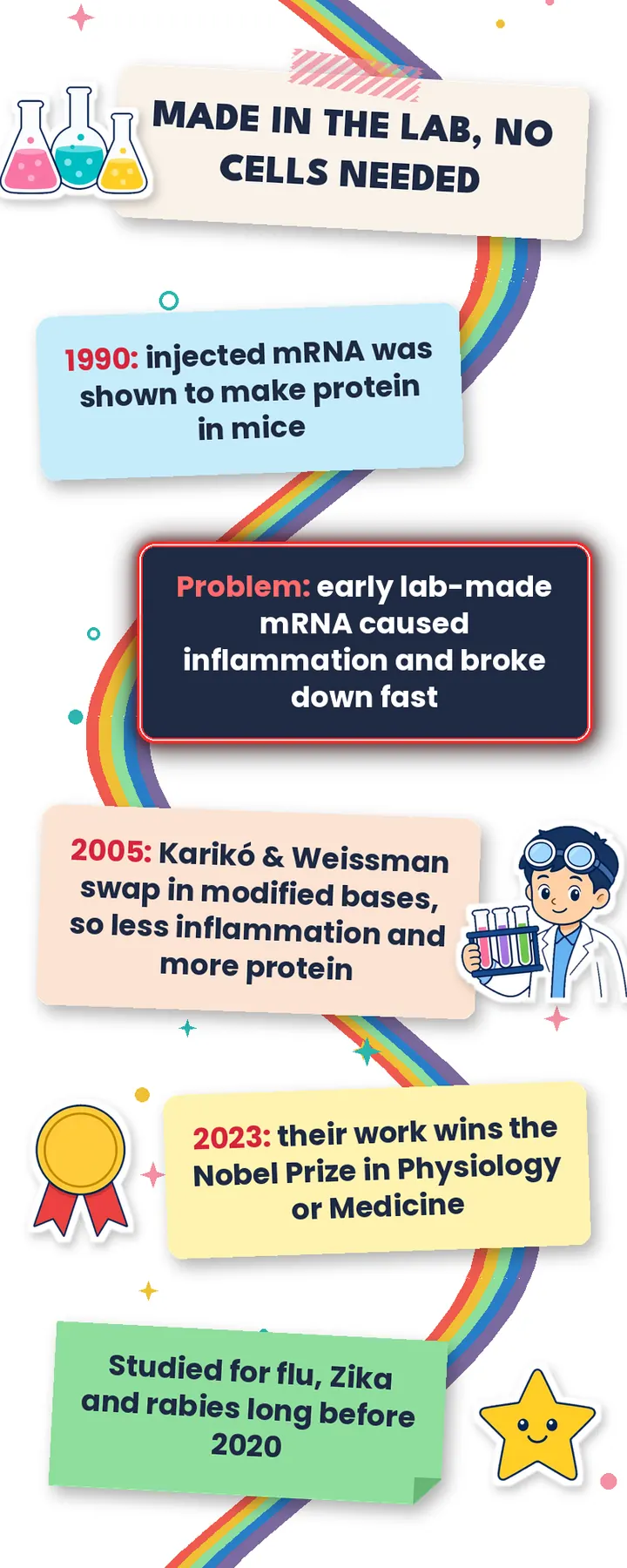
The matching mRNA is then made in the lab, with no cells involved. For years this part was a headache. Lab-made mRNA triggered inflammation, and it fell apart before it could do much.
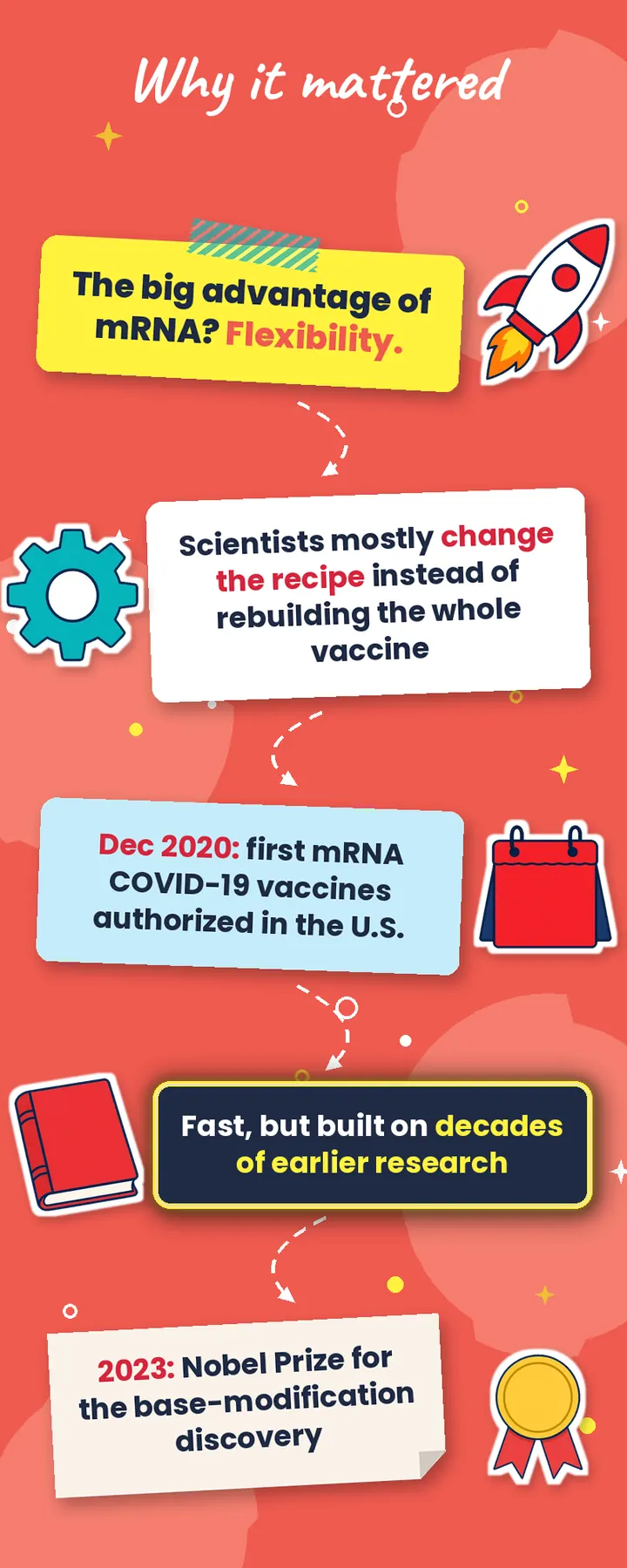
Katalin Karikó and Drew Weissman found the fix. They swapped one of mRNA’s building blocks (its “bases”) for a slightly modified version. The message caused far less inflammation and made much more protein. Their work earned the 2023 Nobel Prize in Physiology or Medicine.
None of this happened overnight. As Pardi and colleagues described in 2018, researchers had been studying mRNA vaccines for flu, Zika, rabies and other targets well before the pandemic put them in the news.
Step 2: Wrapping it in a lipid nanoparticle
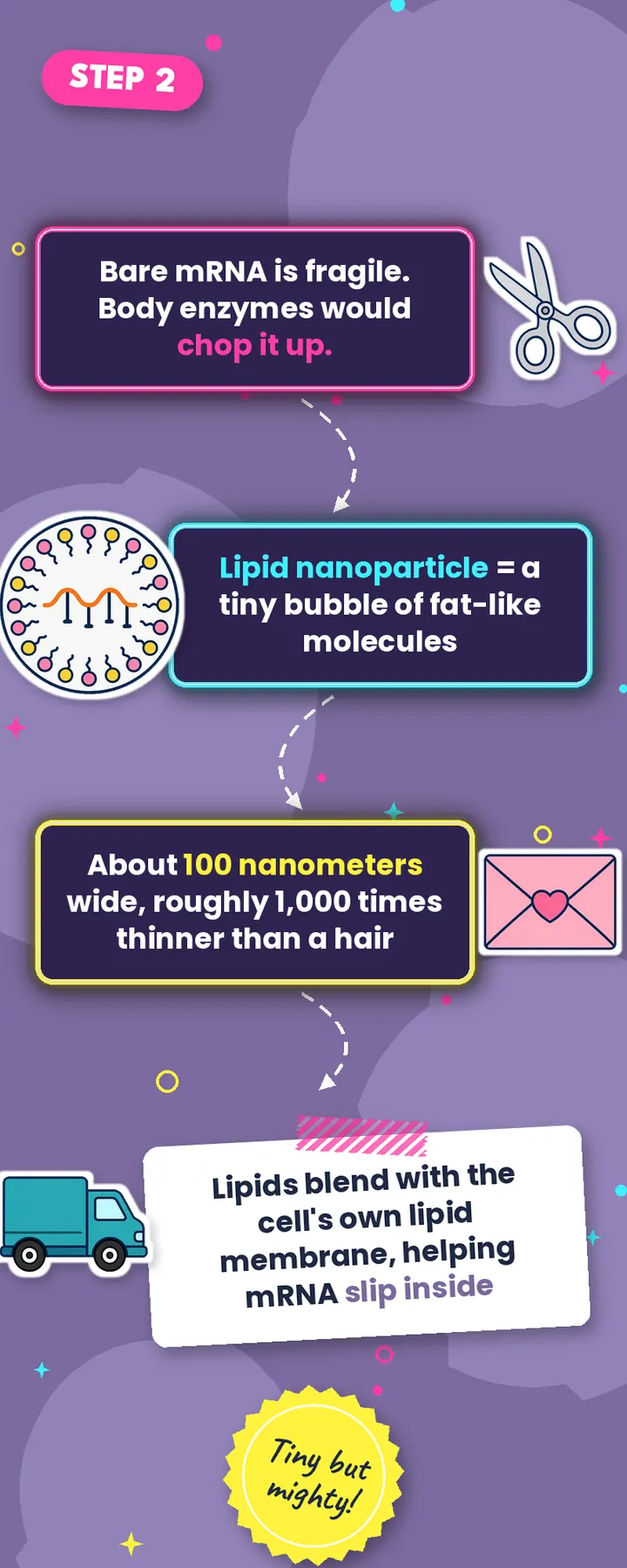
On its own, mRNA is fragile. Enzymes in the body would chop it up long before it reached a cell.
So it travels inside a lipid nanoparticle. That’s a tiny bubble made of fat-like molecules, a bit like a protective envelope. It keeps the message safe on the way in. It also helps the mRNA get through the cell’s outer membrane, which is made of lipids too.
Honestly, these particles deserve their own post, and they’ll get one when I write about nanoparticles in medicine.
Step 3: Getting into your cells
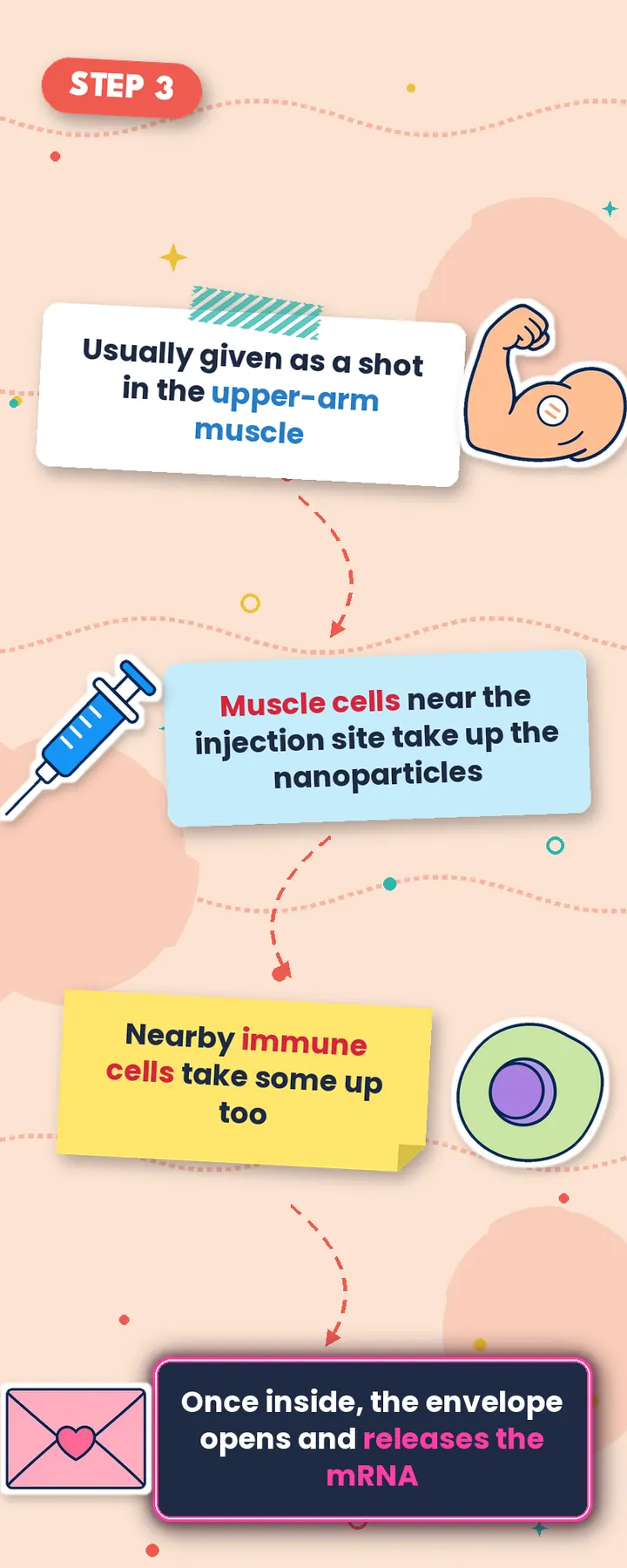
The vaccine is usually given as a shot in the upper arm muscle. Muscle cells near the injection site take up the nanoparticles, and so do nearby immune cells. Once inside, the envelope opens and releases the mRNA.
Myth check: mRNA doesn’t change your DNA
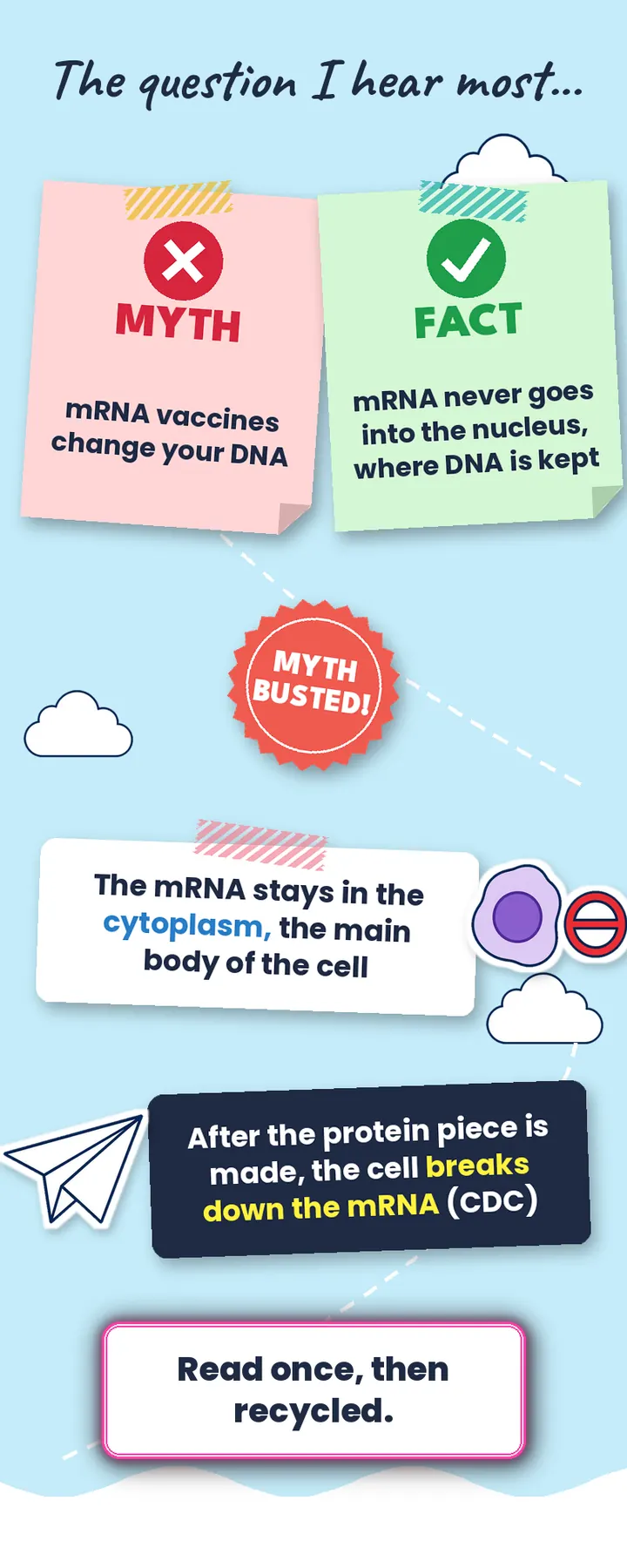
I get asked this more than anything else. The short answer is no. mRNA vaccines don’t change your DNA or interact with it.
Here’s why. The mRNA stays in the cytoplasm, the main body of the cell. It never goes into the nucleus, which is where your DNA is kept. And as the CDC explains, after the protein piece is made, the cell breaks down the mRNA and gets rid of it.
The note gets read once, then recycled.
Step 4: Your cells make the protein
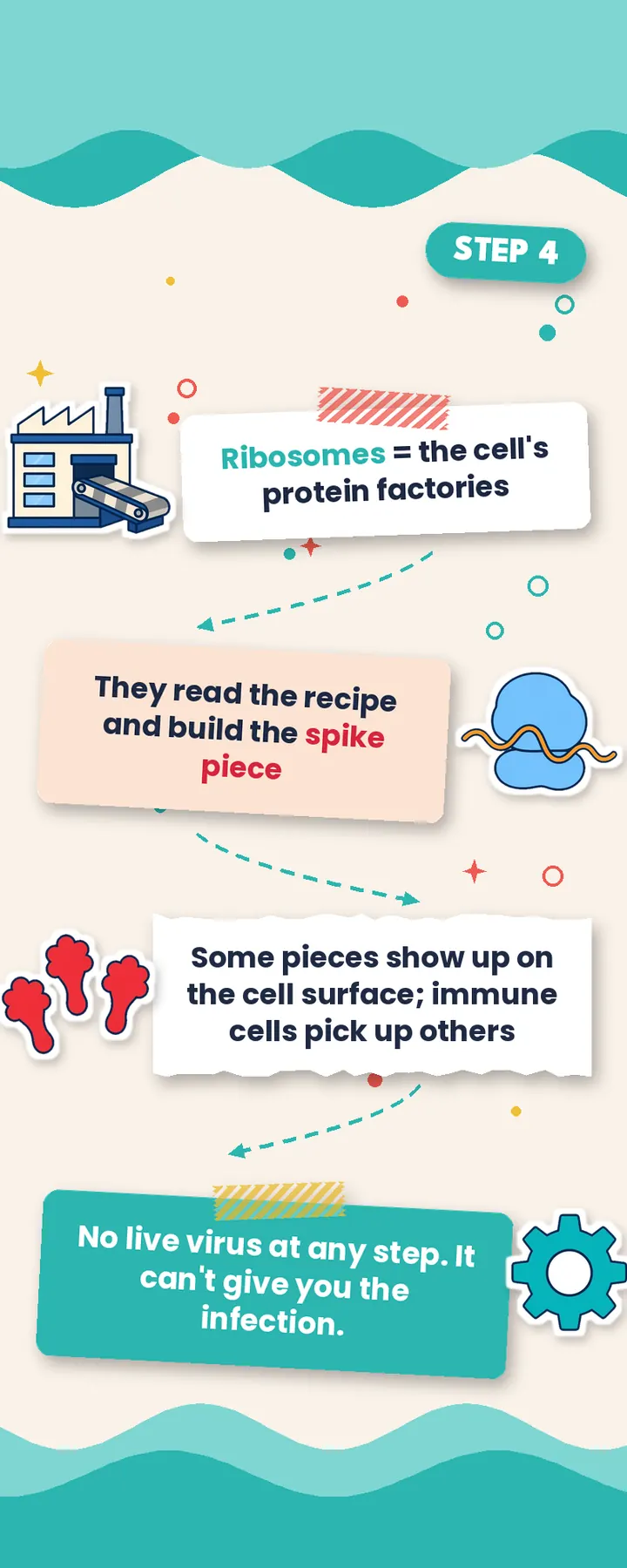
Next, the cell’s ribosomes (its protein factories) read the recipe. They build the target protein the same way they’d build any other.
Some of the protein ends up on the surface of the cell. Immune cells pick up some of it, too. Either way, the immune system gets a good look at the wanted poster.
There’s no live virus anywhere in this process. That means the vaccine can’t give you the infection it’s meant to protect against.
Step 5: The immune response
Your immune system spots the unfamiliar protein and treats it as foreign. This is where protection starts to build.
Antibodies
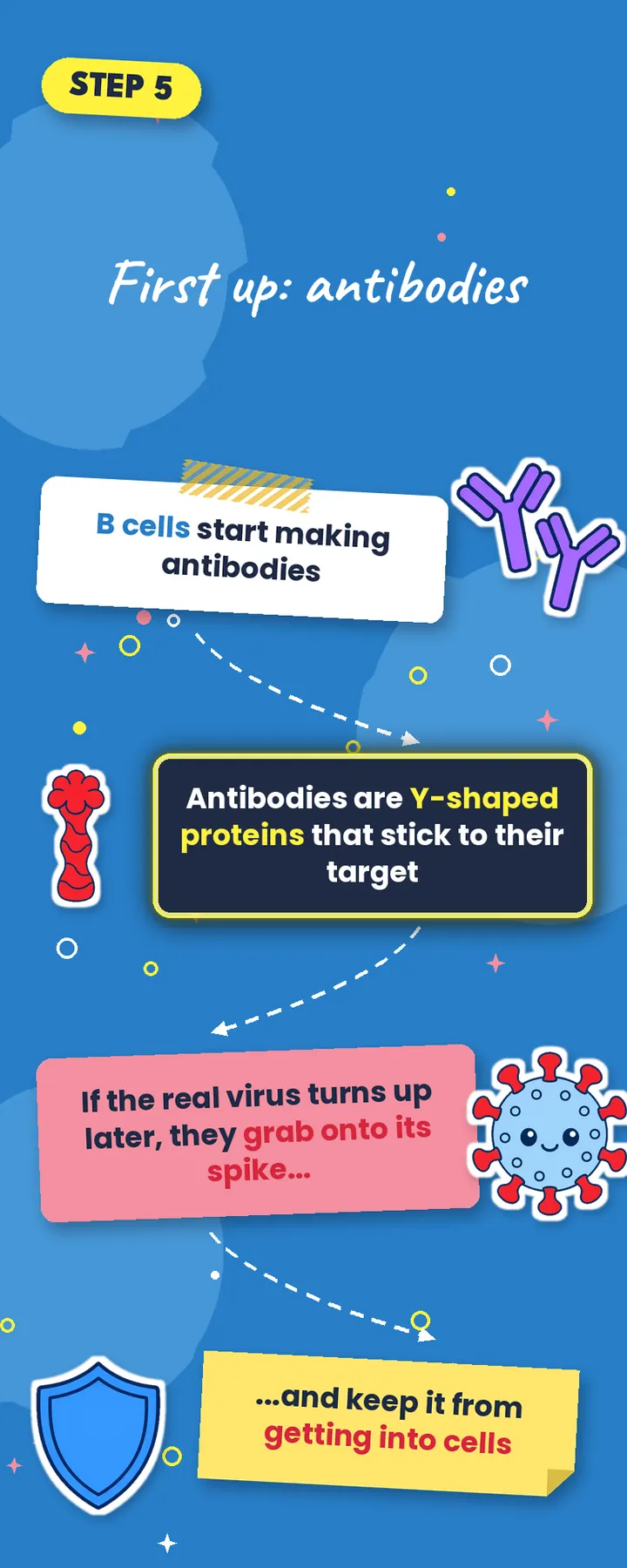
B cells start making antibodies. These are Y-shaped proteins that stick to their target. Later, if the real virus turns up, those antibodies can grab onto its spike and keep it from getting into cells.
T cells
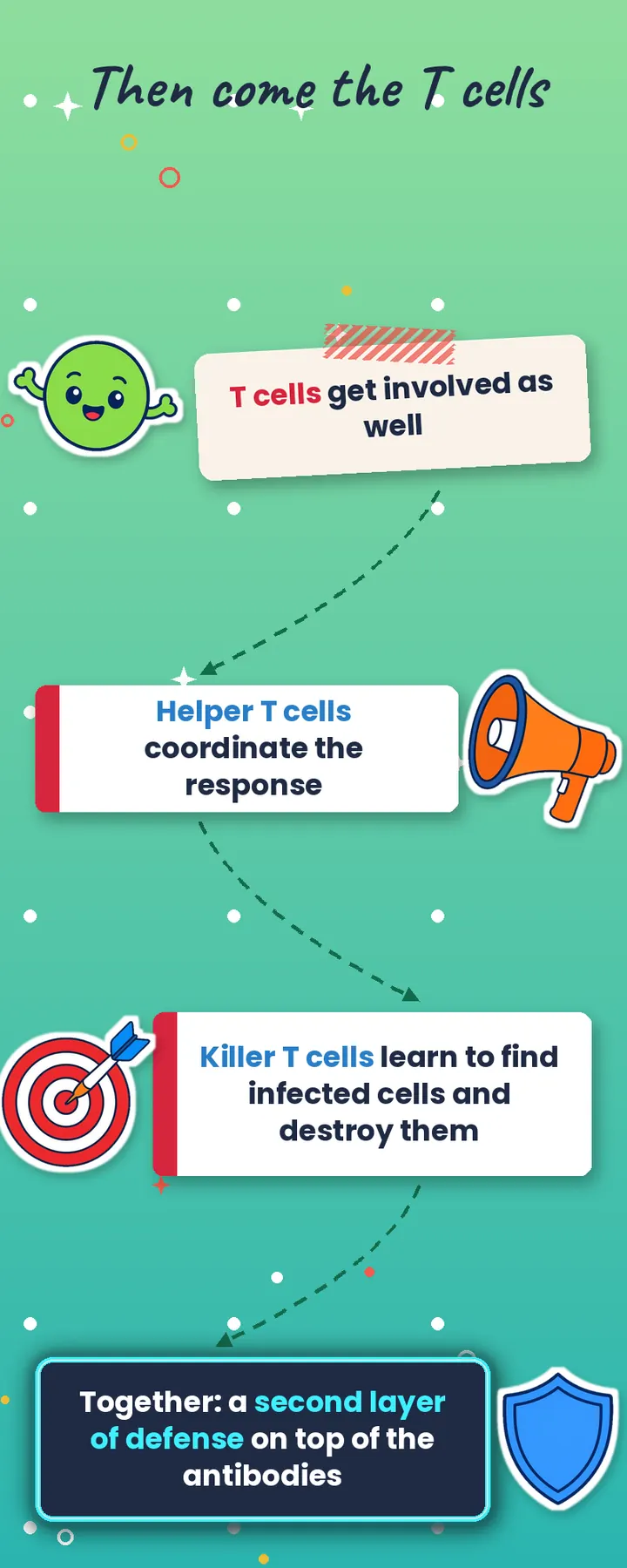
T cells get involved as well. Helper T cells coordinate the response, while killer T cells learn to find infected cells and destroy them. This adds a second layer of defense on top of the antibodies.
Why your arm might be sore
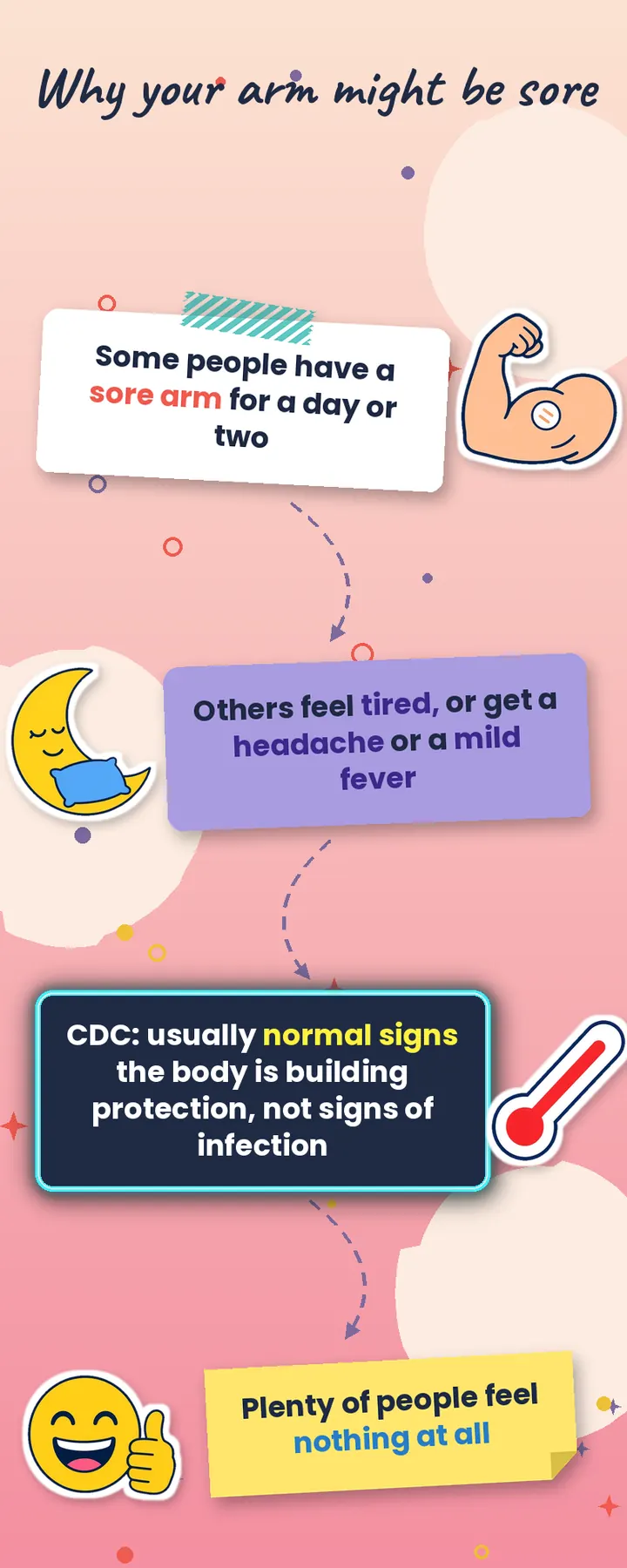
Some people have a sore arm for a day or two. Others feel tired, or get a headache or a mild fever. The CDC says these are usually normal signs that the body is building protection, not signs of infection. Plenty of people feel nothing at all.
Step 6: Immune memory
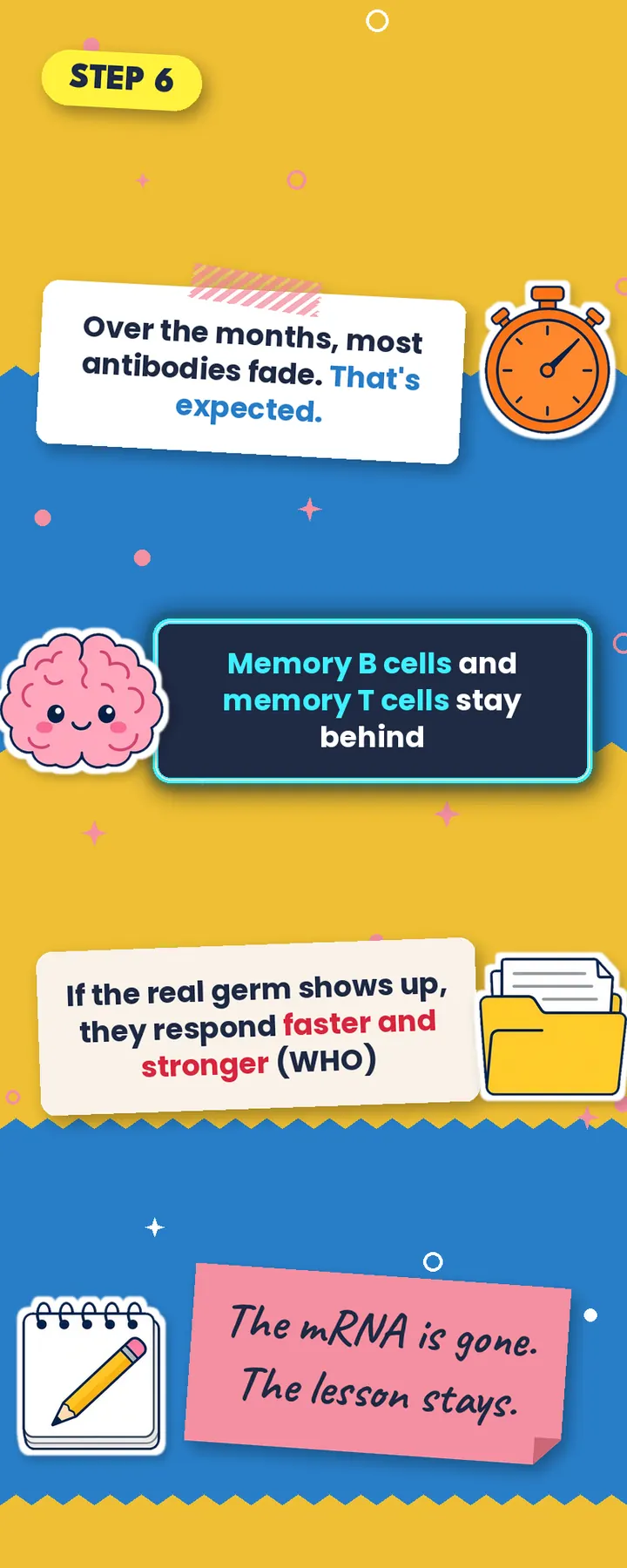
Over the following months, most of those antibodies and active immune cells fade. That’s expected. What stays behind are memory B cells and memory T cells.
The World Health Organization describes memory cells as the body’s long-term record of a germ. If the real germ shows up later, these cells recognize it. They respond faster and more strongly than they did the first time, and that faster response is what we mean by protection.
By this point the mRNA is long gone, and so is the protein. The memory is what’s left.
How mRNA vaccines differ from traditional vaccines
Traditional vaccines, such as live, inactivated and subunit vaccines, show the immune system the germ itself or a piece of it that was made ahead of time. An mRNA vaccine instead gives your cells the instructions, and your cells make the protein piece themselves. For a side-by-side look at the other kinds, see my post on vaccine types and classification.
It’s also a different route from recombinant DNA technology, which uses living host cells in a lab to manufacture a protein before it is purified for use. With mRNA, the protein is made inside your own cells after the shot.
Why it mattered, and what’s next
The big advantage of mRNA is flexibility. Once the platform exists, scientists mostly change the recipe instead of rebuilding the whole vaccine. That’s a big part of why the COVID-19 vaccines came together so quickly, on top of decades of earlier research.
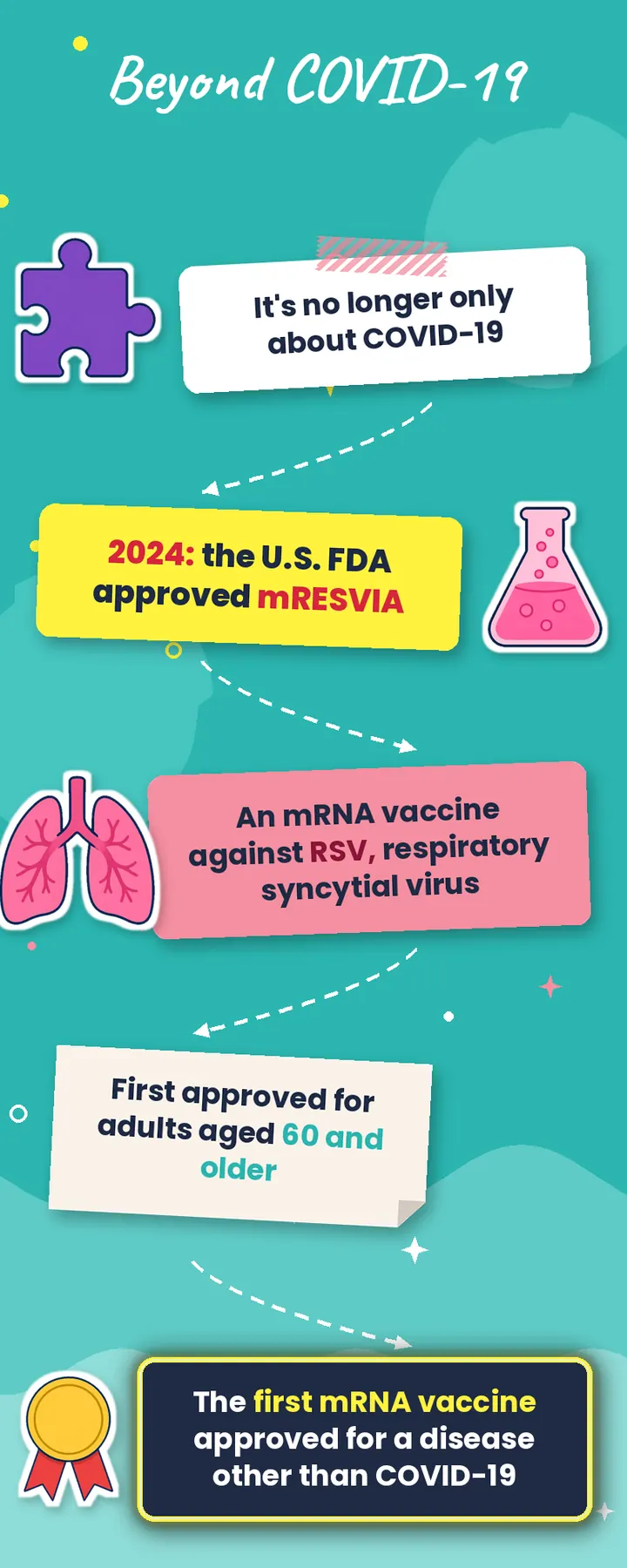
And it’s no longer only about COVID-19. In 2024, the U.S. FDA approved mRESVIA, an mRNA vaccine against respiratory syncytial virus (RSV), first for adults aged 60 and older. It was the first mRNA vaccine approved for a disease other than COVID-19.
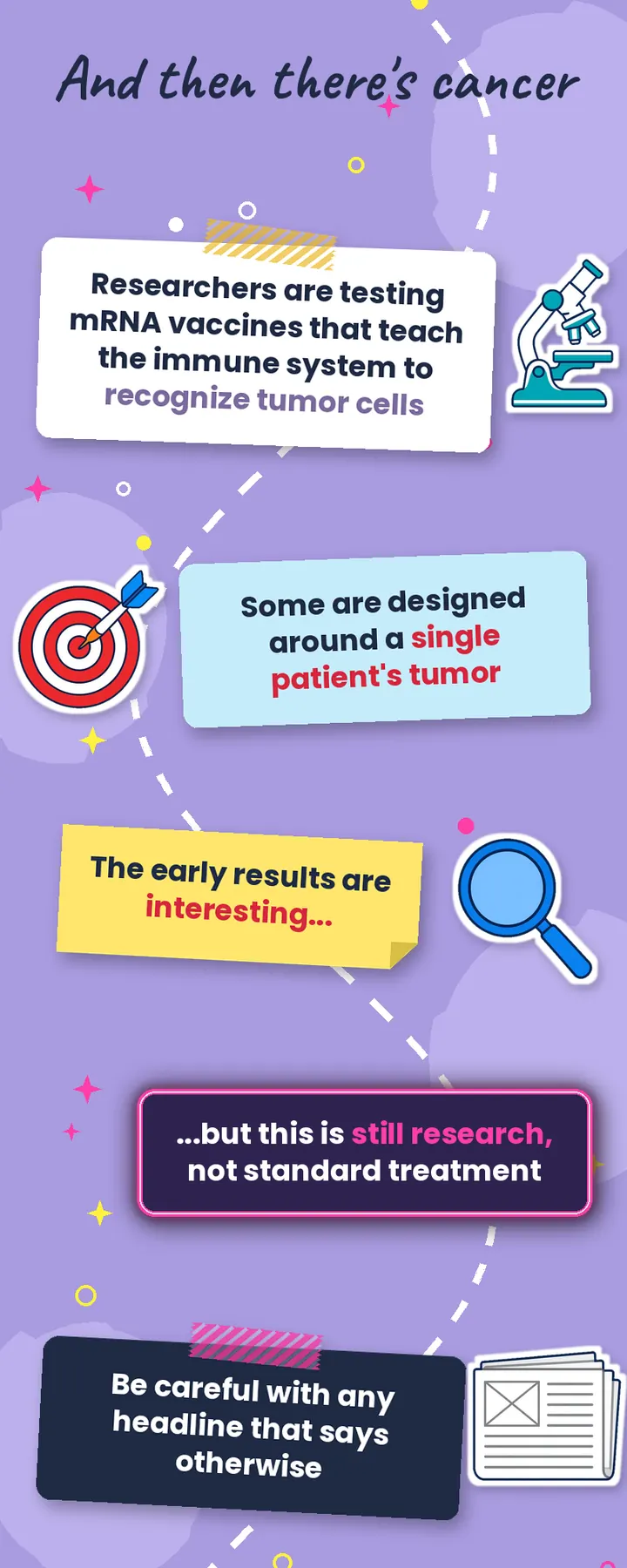
Then there’s cancer. Researchers are testing mRNA vaccines that teach the immune system to recognize tumor cells, sometimes designed around a single patient’s tumor. The early results are interesting. But this is still research, not standard treatment, so be careful with any headline that says otherwise.
Key takeaways
- mRNA is a short-lived recipe your cells use every day.
- An mRNA vaccine delivers the recipe for one harmless piece of a germ, packed inside a lipid nanoparticle.
- The mRNA never enters the nucleus and doesn’t change your DNA. Cells break it down after use.
- Your immune system learns from that protein and makes antibodies and T cells.
- Memory cells stay behind so the next response is faster.
- The same platform is now used against RSV. Cancer uses are still being studied.
FAQ: how mRNA vaccines work
Do mRNA vaccines change your DNA?
No. The mRNA stays in the cytoplasm, never enters the nucleus where DNA is kept, and is broken down by the cell after use.
Why is a lipid nanoparticle used?
mRNA is fragile. The lipid nanoparticle protects it on the way in and helps it get into cells.
Can an mRNA vaccine give you the infection?
No. There is no live virus in the process, only instructions for one harmless piece of it.
How long does the mRNA last in the body?
It isn’t meant to last. Cells break it down after the protein is made, while memory B and T cells remain.
This article is for educational purposes only and is not medical advice. It does not recommend any specific vaccine, dose or schedule. Please talk to your doctor or a qualified healthcare provider about decisions related to your own health.